Let’s Buy Spirit Explained: What Happened, How It Worked, and What Comes Next.
Introduction
Let’s Buy Spirit was a viral 2026 campaign that attempted to rally ordinary travelers behind the idea of collectively buying and reviving Spirit Airlines. The campaign began after Spirit Airlines stopped operating on May 2, 2026, with creator Hunter Peterson proposing that passengers and supporters could pool their commitments to create a community-owned airline.
The idea spread rapidly online. However, there is an important distinction between pledges and actual investment capital: the early campaign figures represented non-binding expressions of interest rather than money sitting in a bank account ready to purchase an airline.
The story has since changed. The original attempt to acquire Spirit’s assets did not succeed, and the project moved toward creating a new membership-based airline rather than simply bringing the old Spirit Airlines back. By September 2026, the project was being presented as First Jet Airways, described by its founder as a cooperative, membership-focused airline concept.
Quick Answer: What Is Let’s Buy Spirit?
| Question | Short Answer |
|---|---|
| What was Let’s Buy Spirit? | A grassroots campaign to acquire and revive Spirit Airlines through public participation. |
| Who started it? | Content creator and voice actor Hunter Peterson. |
| Why did it start? | Spirit Airlines ceased operations on May 2, 2026. |
| Did people actually send hundreds of millions of dollars? | No. The early headline figures were non-binding pledges, not equivalent to cash raised. |
| Did the campaign buy Spirit Airlines? | No. Spirit entered an orderly wind-down and liquidation process. |
| What happened next? | The project shifted toward building a new airline. |
| What is the new project called? | First Jet Airways, according to September 2026 reporting and Peterson’s public posts. |
| Is First Jet already operating flights? | No evidence found in the research indicates that it is currently operating scheduled passenger flights. |
What Is Let’s Buy Spirit?
Let’s Buy Spirit was an internet-driven campaign built around a simple question: could ordinary people collectively finance the revival of Spirit Airlines?
The campaign emerged almost immediately after Spirit ceased operations. Hunter Peterson, a content creator and voice actor who had previously attracted attention for his interest in Spirit Airlines, proposed the idea on social media.
His basic calculation was straightforward. If a large enough number of American adults contributed an amount roughly comparable to the price of a Spirit ticket, the resulting pool could theoretically reach the billions of dollars needed for an airline transaction.
That concept resonated with people who had used Spirit because of its low fares.
The campaign then developed into what supporters called Spirit 2.0, with a proposed community-ownership structure.
The important point is that this was not initially a conventional airline acquisition fund. People were registering interest and making non-binding pledges rather than transferring the full pledged amounts to an acquisition account. Contemporary reporting specifically noted that the pledge totals should not be interpreted as cash raised.
Why Did Spirit Airlines Shut Down?
Understanding the campaign requires understanding what happened to Spirit itself.
Spirit Airlines announced on May 2, 2026, that it had begun an orderly wind-down of operations. The company cancelled all flights and told passengers not to go to airports for Spirit departures.
According to Spirit’s own restructuring announcement, the wind-down followed unsuccessful efforts to restructure the business and strengthen its financial position. The company specifically cited a material increase in oil prices and other financial pressures.
Spirit had already been dealing with serious financial difficulties and bankruptcy proceedings before the shutdown.
That distinction matters because Let’s Buy Spirit did not start with a healthy airline waiting for a new owner. The campaign appeared after the airline had entered a formal wind-down and liquidation process.
Buying an airline in that situation is fundamentally different from purchasing a normal operating company.
How Did the Let’s Buy Spirit Campaign Start?
Peterson’s original social-media pitch gained attention because the concept was easy to understand.
Instead of asking one billionaire or investment firm to purchase Spirit, the idea was to involve a large community of passengers.
The proposed philosophy was closer to community ownership than traditional airline ownership.
The campaign attracted tens of thousands of participants within days, and reported pledge totals increased rapidly as social media attention grew. Early reports showed tens of millions of dollars in pledges, followed by substantially larger figures later in May.
The website also experienced periods of heavy traffic, which became part of the story itself.
But viral attention created a second problem: moving from an online pledge campaign to a legally compliant, adequately funded airline acquisition.
Those are very different stages.
How Did the Crowdfunding Model Work?
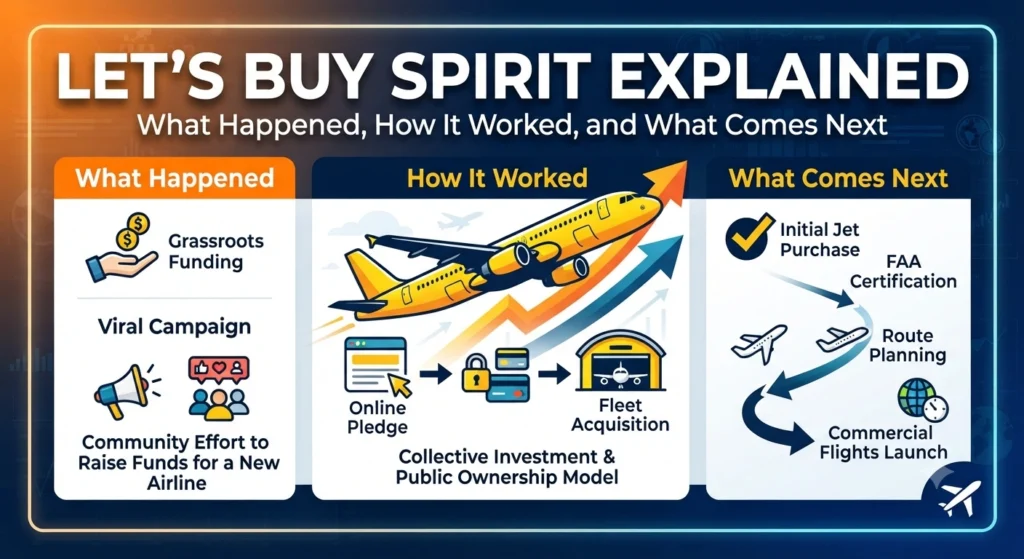
The original model can be understood in three steps.
1. People expressed interest
Supporters could submit a pledge indicating how much they would potentially contribute.
The campaign initially emphasized that these were non-binding pledges.
2. The campaign measured public demand
The pledge count gave organizers a way to demonstrate that there was significant public interest in the concept.
This created a large online audience and potentially useful market validation.
3. The project would need real capital
Eventually, however, an airline acquisition would require actual financing, legal structures, regulatory work, negotiations and participation in the bankruptcy process.
That is where the difference between a viral campaign and an acquisition became particularly important.
A website displaying hundreds of millions of dollars in pledges does not mean hundreds of millions of dollars are available for an acquisition.
How Much Money Was Actually Raised?
This is one of the most important questions surrounding Let’s Buy Spirit.
During the campaign’s viral phase, reported pledges reached hundreds of millions of dollars. One later report put the figure at approximately $437 million in non-binding pledges from more than 500,000 people.
That number should not be described as $437 million in investment capital.
Later fundraising efforts attempted to move beyond pledges and toward actual investment. Reporting published in September 2026 said the campaign raised approximately $2.2 million from about 443 investors, below a reported $5 million minimum contemplated for the Spirit acquisition effort.
This is the clearest information gain for anyone researching the phrase “Let’s Buy Spirit money raised.”
Pledges vs. actual capital
$437 million in pledges ≠ $437 million available for purchase.
The distinction is critical when evaluating crowdfunding campaigns, investment projects and viral fundraising claims generally.
Why Couldn’t the Campaign Simply Buy Spirit?
An airline is not just a brand and a collection of aircraft.
A functioning airline depends on aircraft, airport access, employees, maintenance arrangements, financing, regulatory approvals, operating authority, technology, insurance, schedules, contracts and many other components.
Spirit was also undergoing a formal bankruptcy and liquidation process.
The court process determined how assets could be sold. Some assets could be auctioned separately rather than transferred together as a complete operating airline.
Spirit’s restructuring materials confirm that the company began winding down and liquidating its operations after May 2.
Consequently, a community campaign could not simply announce that it had enough supporters and take control of the airline.
It needed to participate within the legal and financial framework governing the liquidation.
What Happened to Spirit Airlines’ Assets?
Spirit’s assets did not remain untouched while the crowdfunding campaign developed.
The bankruptcy process involved separate transactions and auctions involving different assets.
For example, a Federal Register document states that Spirit’s 22 LaGuardia slots were subject to a competitive bidding process, with JetBlue becoming the successful bidder. The bankruptcy court subsequently approved the transaction subject to regulatory requirements.
That illustrates a fundamental challenge for the original Let’s Buy Spirit concept.
By the time the campaign gained momentum, Spirit was being dismantled as a corporate operating system.
Buying selected assets is not necessarily the same thing as buying an operating airline.
What Is Spirit 2.0?
Spirit 2.0 was the name associated with the proposed community-owned successor to Spirit Airlines.
The original vision emphasized passengers, workers and communities having a meaningful role in ownership.
The concept also drew comparisons with community-ownership models such as the Green Bay Packers.
However, Spirit 2.0 should not be confused with the original Spirit Airlines company.
It was a proposed successor concept rather than a continuation of the airline’s existing operations.
That distinction is especially important for searches such as:
- Spirit 2.0 airline
- Spirit 2.0 crowdfunding
- Spirit 2.0 investment
- Spirit 2.0 stock
- Spirit Airlines revival
- Let’s Buy Spirit investment
Why Did the Project Change Direction?
The original acquisition strategy ultimately did not succeed.
By August 2026, reporting indicated that the project had shifted from buying Spirit to building a new airline. The reworked concept was described as a membership-based airline similar in broad consumer logic to Costco: members would receive access to lower fares or other benefits, while the company would build a new airline operation rather than purchase Spirit’s existing corporate structure.
This was a major strategic change.
The original question was:
Can the public buy Spirit Airlines?
The newer question became:
Can the community build a new airline?
Those are two completely different business propositions.
What Is First Jet Airways?
By early September 2026, Peterson was publicly describing the project as First Jet Airways.
The project has been presented as a cooperative, membership-oriented airline concept and has been described as the successor to Spirit 2.0. Peterson has used the phrase “the Costco of airlines” to describe the intended model.
The important caveat is that a business concept is not the same as an operating airline.
As of the research date, there is no reliable evidence establishing that First Jet Airways has begun normal scheduled passenger operations.
Therefore, searches such as “First Jet Airways flights,” “First Jet Airways booking” or “First Jet Airways routes” should be treated carefully until the company publishes verifiable operational information.
Is Let’s Buy Spirit Legitimate?
The answer depends on what “legitimate” means.
As an internet campaign
Yes, the campaign was a real public initiative that attracted substantial attention and participation.
As a completed Spirit acquisition
No.
The campaign did not successfully acquire Spirit Airlines.
As a source of investment returns
That requires much more caution.
A pledge did not automatically represent an investment, ownership stake or guaranteed financial return. Earlier campaign materials reportedly warned that participation did not guarantee ownership or financial gain.
The newer First Jet concept is a separate business initiative and should be evaluated according to its own corporate, regulatory and investment documentation.
Is Let’s Buy Spirit Safe?
People should distinguish between following a campaign and sending money to an investment offering.
The original pledge concept was presented as non-binding, but later investment activity involves a different level of financial risk.
Before providing money to any project connected with the campaign, check:
- The exact legal entity receiving funds.
- Whether the transaction is an investment, membership payment, donation or reservation.
- Whether formal offering documents exist.
- Whether securities regulators have approved or qualified the relevant offering where required.
- The refund and cancellation terms.
- Who controls the money.
- Whether ownership rights are clearly documented.
- Whether the website is an official domain.
Also be particularly careful with cryptocurrency tokens using the name “Lets Buy Spirit.” Search results show unrelated SPIRIT tokens on Solana, including unverified tokens. Those should not automatically be treated as connected to the airline campaign.
Current Status of Let’s Buy Spirit
As of September 21, 2026, the most useful way to understand the project is as a story with several stages:
Spirit Airlines shuts down → Let’s Buy Spirit launches → massive non-binding pledges → attempt to raise real acquisition capital → Spirit assets proceed through liquidation → acquisition effort fails → project pivots toward building a new airline → First Jet Airways emerges.
The original Spirit Airlines is not operating scheduled flights.
Spirit’s restructuring website continues to state that the airline is winding down operations, while bankruptcy-related processes continue.
Meanwhile, the former campaign domain has changed status. The letsbuyspirit.com domain currently does not provide the original campaign experience, while letsbuyspiritair.com redirects to First Jet’s website.
That is an important current-status update for people finding old articles that still describe Let’s Buy Spirit as an active attempt to purchase Spirit Airlines.
Let’s Buy Spirit vs. Buying an Airline Stock or Ticket
These concepts are easy to confuse, but they are completely different.
| Option | What You Are Doing |
|---|---|
| Let’s Buy Spirit pledge | Expressing interest in a proposed community project |
| Airline investment | Purchasing a financial interest under formal investment terms |
| Airline ticket | Purchasing transportation from an operating carrier |
| Airline membership | Paying for benefits offered by an airline or travel company |
| Cryptocurrency token | Buying a digital asset whose value depends on its own market and issuer/community |
A Let’s Buy Spirit pledge should therefore never automatically be interpreted as buying Spirit Airlines stock.
Who Was Let’s Buy Spirit For?
The original campaign primarily appealed to:
- Former Spirit passengers
- Budget travelers
- Aviation enthusiasts
- People interested in cooperative ownership
- Social-media communities
- Supporters of community-driven businesses
- People who wanted affordable airline travel to remain available
The campaign was particularly effective at turning a complicated bankruptcy story into a simple public question: Could passengers collectively become the owners?
That simplicity helped explain its rapid spread online.
Common Problems and Risks
Confusing pledges with money
This is the biggest misunderstanding.
A pledge represents an intention, not necessarily available cash.
Assuming the old Spirit can simply return
Spirit’s operating business entered an orderly wind-down and liquidation process. Recreating an airline requires substantially more than restoring its website and repainting aircraft.
Trusting outdated articles
Many articles were published in May 2026 when the campaign was still trying to acquire Spirit.
Those articles can be misleading today because the project later changed direction.
Confusing unrelated tokens with the airline project
Several cryptocurrency tokens have used the SPIRIT name.
A token’s name alone does not establish an official relationship with an airline campaign.
Assuming social-media popularity equals financial capacity
A campaign can generate enormous attention without having the capital required to operate an airline.
That distinction is one of the most useful lessons from the Let’s Buy Spirit story.
Practical Tips for Researching Let’s Buy Spirit
If you are researching the campaign today, use this checklist:
Check the date
A May 2026 article may describe the original acquisition proposal, while a September 2026 article may describe First Jet Airways.
Separate pledges from investments
Look for words such as pledge, non-binding, investment, offering, membership, subscription and securities.
They do not mean the same thing.
Verify the legal entity
Don’t assume every website using “Spirit 2.0” or “Let’s Buy Spirit” belongs to the same organization.
Check official sources
For Spirit’s shutdown and bankruptcy matters, use Spirit’s restructuring information and court-related documents.
For any new airline investment, look for current corporate and regulatory documentation.
Don’t rely on follower counts
Large social-media numbers can demonstrate interest, but they do not establish financial strength, regulatory approval or airline operating capability.
FAQs About Let’s Buy Spirit
What is Let’s Buy Spirit?
Let’s Buy Spirit was a 2026 grassroots campaign that attempted to rally public support for acquiring and reviving Spirit Airlines after the carrier ceased operations.
Who started Let’s Buy Spirit?
The campaign was started by content creator and voice actor Hunter Peterson, who promoted the idea through social media shortly after Spirit Airlines shut down.
Did Let’s Buy Spirit actually buy Spirit Airlines?
No. The campaign did not complete an acquisition of Spirit Airlines. Spirit entered an orderly wind-down and liquidation process.
How much money did Let’s Buy Spirit raise?
The campaign reported hundreds of millions of dollars in non-binding pledges at its peak. Later reporting indicated that approximately $2.2 million was actually raised from around 443 investors during an attempted formal investment phase, below a reported $5 million minimum for the contemplated acquisition.
Is Spirit Airlines coming back?
The original Spirit Airlines ceased passenger operations on May 2, 2026. The later project associated with Spirit 2.0 moved toward building a new airline rather than restoring the old Spirit operating company.
What happened to Spirit 2.0?
Spirit 2.0 evolved after the attempt to acquire Spirit failed. By late August and early September 2026, the project had shifted toward creating a new membership-based airline, eventually presented as First Jet Airways.
Is First Jet Airways the same as Spirit Airlines?
No. First Jet Airways is presented as a new airline project associated with the former Spirit 2.0 initiative. It is not the same corporate entity as Spirit Airlines.
Is Let’s Buy Spirit a cryptocurrency?
No. The original Let’s Buy Spirit campaign was an airline acquisition/community-ownership initiative. Separate cryptocurrency tokens using the name “Lets Buy Spirit” have appeared on Solana, and at least some are explicitly marked as unverified.
Conclusion
Let’s Buy Spirit was more than a viral slogan, but it was not a completed airline acquisition. It began as an ambitious attempt to use mass public participation to acquire and revive Spirit Airlines after its May 2026 shutdown.
The campaign demonstrated how quickly social media can turn a simple idea into a large community movement. At the same time, it highlighted the enormous difference between public enthusiasm, non-binding pledges and actual investment capital.
Spirit Airlines’ liquidation made the original acquisition strategy increasingly difficult, and the project eventually changed direction. By September 2026, the initiative had evolved into First Jet Airways, a proposed membership and cooperative airline intended to be built from the ground up rather than simply restore Spirit.
For readers researching “Let’s Buy Spirit” today, the most important takeaway is therefore simple: do not rely on early May 2026 coverage alone. The project has changed substantially, and the original goal of buying Spirit Airlines is no longer the current story.