
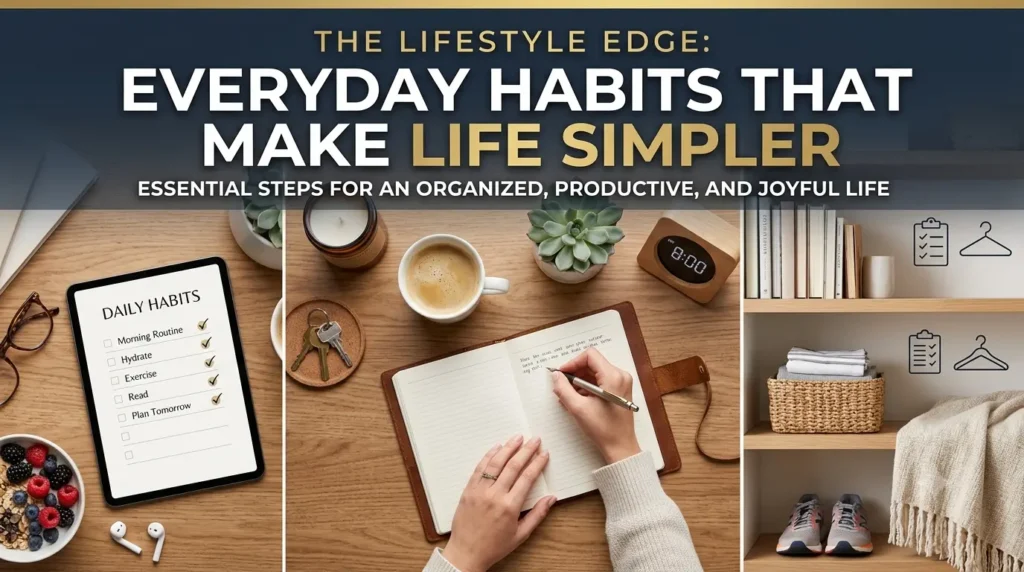
The Lifestyle Edge: Everyday Habits That Make Life Simpler.
Introduction
Improving your lifestyle doesn’t always require a major transformation. Sometimes, a better day starts with a few small habits: putting things back where they belong, planning tomorrow before going to bed, making time for something enjoyable, or simply deciding what deserves your attention.
The Lifestyle Edge is about finding practical ways to make everyday living more comfortable, organized, and intentional.
Rather than following complicated routines, the focus is on habits that can fit naturally into real life. Some may help you save time, while others can reduce unnecessary decisions, improve your surroundings, or create more room for personal interests.
The important part is not how many habits you adopt. It’s whether the habits you choose genuinely improve the way you live.
What Is The Lifestyle Edge?
The Lifestyle Edge is a practical approach to building everyday habits that support a more organized and enjoyable lifestyle.
It isn’t a strict formula.
Your Lifestyle Edge might come from:
- Better organization
- Smarter planning
- Simpler routines
- More intentional spending
- Less digital clutter
- More personal time
- Useful skills
- Stronger daily boundaries
The idea is to focus on improvements that are useful in your actual circumstances.
A habit that makes your life easier is more valuable than one that simply looks impressive.
1. Build Habits Around Real Problems
The best starting point is often a recurring problem.
Think about something that regularly causes inconvenience.
For example:
- You forget important tasks.
- Your mornings feel rushed.
- Your workspace becomes cluttered.
- You spend too much time searching for things.
- Your phone interrupts you constantly.
- You struggle to make time for hobbies.
Once you’ve identified the problem, create a small habit around it.
If you frequently forget appointments, make checking your calendar part of your daily routine.
If your mornings are chaotic, prepare essential items the evening before.
2. Keep Your Habits Practical
A habit should be easy enough to repeat.
Instead of creating a long morning checklist, start with two or three useful actions.
For example:
- Review the day’s schedule.
- Identify your main priority.
- Prepare to begin.
You can expand the routine later if necessary.
3. Use Existing Routines as Reminders
You don’t always need a separate reminder for every habit.
Connect new habits to things you already do.
For example:
After breakfast → review your priorities.
After work → organize your workspace.
Before bed → check tomorrow’s commitments.
This creates a natural sequence.
The Lifestyle Edge at Home
Your surroundings can either make daily tasks easier or create unnecessary friction.
4. Give Everything Important a Consistent Place
Choose a regular location for things you use frequently.
Examples:
- Keys
- Wallet
- Work bag
- Important papers
- Chargers
- Everyday accessories
The purpose isn’t perfect organization.
It’s predictability.
When something has a regular home, you spend less time wondering where you left it.
5. Keep Frequently Used Things Accessible
Think about what you use every day.
Those items should generally be easier to reach than things you use only occasionally.
You can organize storage around frequency:
| Usage | Storage approach |
|---|---|
| Daily | Easily accessible |
| Weekly | Convenient but organized |
| Occasional | Less prominent storage |
| Rarely used | Long-term storage |
This makes organization more practical.
6. Use the One-Area Rule
Instead of attempting to declutter an entire home, choose one area.
It could be:
- A desk
- One drawer
- A shelf
- Your bedside table
- A section of your wardrobe
Finish that area before moving to another.
This keeps the process manageable.
7. Make Tidying Part of Your Routine
Small resets can be easier than large cleanups.
At the end of the day, spend a few minutes returning things to their normal places.
Put away documents.
Clear unnecessary items.
Return frequently used objects.
Then stop.
The objective is maintenance, not perfection.
The Lifestyle Edge and Time
Time becomes easier to manage when priorities are clear.
8. Decide What Matters Most
At the beginning of the day, identify your most important responsibilities.
Ask:
What would make today feel productive or meaningful if I completed it?
That answer can become your primary focus.
Smaller tasks can fit around it.
9. Don’t Treat Everything as Urgent
Some tasks feel urgent because they are visible.
That doesn’t necessarily make them important.
Before immediately switching tasks, ask:
- Does this have a real deadline?
- Does someone depend on it?
- What happens if it waits?
- Is it more important than what I’m doing now?
These questions can help protect your priorities.
10. Keep Some Space Open
A completely full calendar leaves little room for reality.
Unexpected tasks appear.
Plans change.
Conversations take longer.
Whenever possible, leave some flexible time.
This can make your schedule easier to adapt.
11. Group Similar Tasks
Instead of constantly switching between different activities, group similar responsibilities where practical.
For example:
Communication
Emails and messages.
Planning
Schedules and upcoming responsibilities.
Errands
Shopping and outside tasks.
Administration
Forms, documents, and routine paperwork.
Grouping similar activities can make recurring work easier to handle.
The Lifestyle Edge and Digital Life
Your digital environment deserves the same attention as your physical surroundings.
12. Control Notifications
Notifications can interrupt you even when you don’t need to respond.
Review the alerts on your devices.
Keep notifications that are genuinely useful.
Reduce those that provide little value.
13. Create a Simple Digital Filing System
Important documents should be easy to find.
You could organize them by:
- Personal
- Work
- Finance
- Travel
- Projects
- Reference
Use names that make sense to you.
Consistency matters more than complexity.
14. Clean Up Your Digital Space Gradually
Don’t wait until your phone or computer becomes completely cluttered.
Regularly remove:
- Duplicate files
- Old downloads
- Unused applications
- Unnecessary screenshots
- Outdated bookmarks
- Emails you no longer need
Handle one category at a time.
15. Create Intentional Phone Breaks
You don’t need to avoid your phone completely.
Instead, create situations where you intentionally put it aside.
For example:
- During meals
- While reading
- During conversations
- While pursuing a hobby
- During focused work
This gives those activities more of your attention.
The Lifestyle Edge and Smarter Decisions
Everyday decisions become easier when you have a few principles to guide them.
16. Ask Whether Something Adds Value
Before making a nonessential purchase or commitment, ask:
“What value will this add to my life?”
The answer doesn’t need to be financial.
It could provide:
- Convenience
- Enjoyment
- Learning
- Connection
- Practical usefulness
If you can’t identify meaningful value, pause before proceeding.
17. Think About Future Maintenance
Some choices create ongoing responsibilities.
Before adding something to your life, consider:
- How much space does it need?
- How much time will it require?
- Will I need to maintain it?
- Will it create additional costs?
- Will I realistically use it?
Thinking about maintenance can help you make more practical decisions.
18. Create Personal Rules
If you repeatedly face the same decision, create a simple rule.
Examples:
“I check my calendar every evening.”
“I compare my existing items before buying another one.”
“I keep important documents in one main folder.”
“I review my upcoming week once a week.”
Rules reduce repeated decision-making.
The Lifestyle Edge and Personal Time
A lifestyle focused entirely on responsibilities isn’t balanced.
19. Keep a Hobby on Your Calendar
Choose something you genuinely enjoy.
It could be:
- Reading
- Sports
- Music
- Cooking
- Art
- Photography
- Gaming
- Gardening
- Walking
Treat it as legitimate personal time.
You don’t have to justify every enjoyable activity through productivity.
20. Make Enjoyment Convenient
If your hobby requires significant preparation every time, you’re more likely to postpone it.
Make the starting point easier.
For example:
- Keep books accessible.
- Store sports equipment together.
- Keep art supplies organized.
- Maintain a playlist for music practice.
- Keep your walking shoes ready.
Reduce the friction between deciding to do something and actually doing it.
21. Protect Time for Relationships
Make space for people who matter.
That could mean:
- Calling someone
- Sharing a meal
- Meeting a friend
- Spending time with family
- Participating in a shared activity
A better lifestyle includes meaningful connections.
The Lifestyle Edge and Personal Growth
Improvement doesn’t need to be constant.
It needs to be useful.
22. Choose One Skill to Develop
Pick a skill that matters to your current life.
Possible areas include:
- Communication
- Writing
- Cooking
- Technology
- Organization
- Professional development
- Creative skills
Focus on practical application.
23. Keep Track of Lessons
When something works well, write it down.
Create a simple note called:
“What Makes My Life Easier.”
You could record:
- Routines that save time
- Systems that prevent mistakes
- Purchases that proved useful
- Habits that improve your day
- Things that consistently create unnecessary work
Over time, you’ll build a personalized lifestyle guide.
24. Review Your Routine Regularly
Your circumstances change.
A routine that worked six months ago may not work now.
Every so often, ask:
- What is still useful?
- What feels unnecessary?
- What keeps causing problems?
- What deserves more attention?
- What could I simplify?
Then make adjustments.
A Simple Weekly Lifestyle Edge Review
Use this checklist once a week.
Home
Is there one area that needs attention?
Schedule
What are the most important upcoming responsibilities?
Digital
What can be removed or organized?
Spending
Are there purchases you actually need to make?
Personal
Have you made room for hobbies or relaxation?
Relationships
Who would you like to connect with?
Next week
What one change would make your week easier?
A Simple Lifestyle Edge Framework
You can summarize the approach in five steps:
| Step | Question |
|---|---|
| Notice | What isn’t working? |
| Reduce | What can I remove? |
| Organize | What needs a better system? |
| Prioritize | What matters most? |
| Maintain | What simple habit keeps it working? |
This framework can be applied to almost any area of everyday life.
Common Mistakes When Improving Your Lifestyle
Changing too much at once
A large collection of new habits can become difficult to maintain.
Copying someone else’s routine
Your lifestyle should reflect your circumstances.
Buying unnecessary solutions
Not every problem requires a product.
Overplanning
Leave room for unexpected events and spontaneous activities.
Ignoring enjoyment
A good lifestyle should include things you genuinely like.
Expecting consistency every day
Life changes. Adjust your routines when necessary.
A 15-Minute Lifestyle Edge Reset
If you want a quick starting point, try this:
Minutes 1–3
Choose one area of your life that feels unnecessarily complicated.
Minutes 4–6
Identify what causes the problem.
Minutes 7–9
Remove one unnecessary step.
Minutes 10–12
Create one simple system or routine.
Minutes 13–15
Prepare for the next time you encounter the problem.
You don’t need a complete lifestyle transformation.
You need one useful improvement.
Frequently Asked Questions About The Lifestyle Edge
What does The Lifestyle Edge mean?
The Lifestyle Edge refers to practical ways of improving everyday life through better habits, organization, planning, and intentional choices. It focuses on useful changes that fit your actual circumstances.
How can I improve my daily routine?
Start by identifying one part of your routine that regularly causes difficulty. Then create a small change that makes that activity easier, such as preparing the night before or creating a consistent sequence.
Does a better lifestyle require a strict routine?
No, a useful lifestyle routine can include flexibility. The purpose of a routine is to provide structure for important activities without making every part of your day rigid.
How can I reduce everyday stress from too many tasks?
Start by separating essential responsibilities from tasks that can wait. A shorter priority list and some open space in your schedule can make your day easier to manage.
How can I make more time for hobbies?
Give hobbies a deliberate place in your schedule and make them easy to start. Keeping the necessary materials accessible can reduce the effort required to begin.
What is one easy Lifestyle Edge habit to start today?
Choose one thing you can prepare today that will make tomorrow easier. It could be your workspace, schedule, clothing, bag, or another frequently used item.
Conclusion
The Lifestyle Edge comes from making everyday life work better—not from trying to create a perfect routine.
Start by paying attention to recurring problems.
Simplify one process.
Organize one space.
Reduce one distraction.
Create one useful habit.
Make time for one activity you enjoy.
Then keep the changes that genuinely help.
Your lifestyle doesn’t need to look like anyone else’s. The most valuable improvements are the ones that fit your responsibilities, preferences, and priorities.
Build your own Lifestyle Edge through small choices that make everyday living clearer, easier, and more enjoyable.