
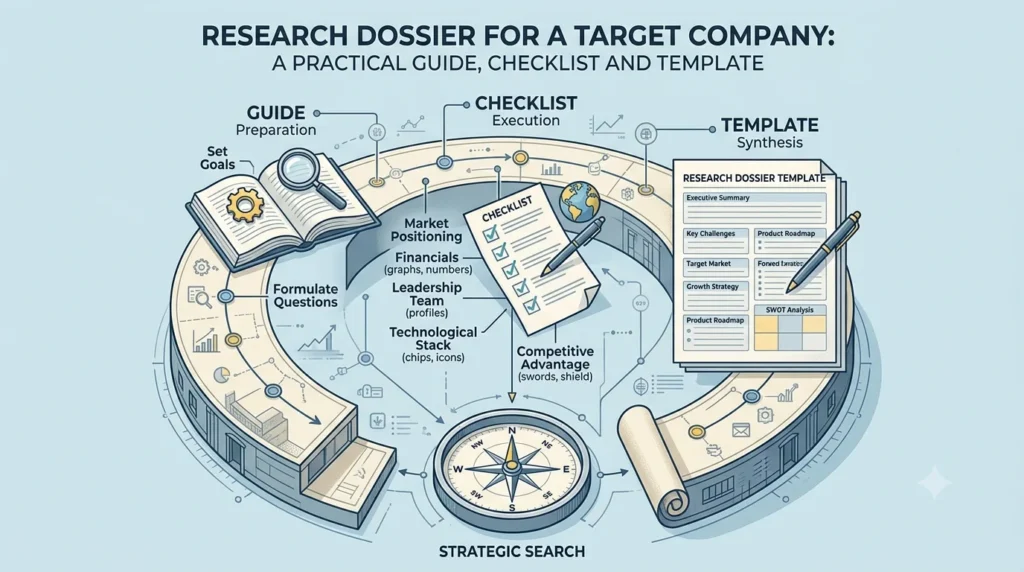
Research Dossier for a Target Company: A Practical Guide, Checklist and Template.
Introduction
Making an important business decision without understanding the company on the other side can create unnecessary risks. Whether you are preparing for a sales meeting, evaluating a potential supplier, researching a competitor, considering an investment or exploring a partnership, basic company information may not be enough.
A company’s website might explain its services and achievements, but it may not provide a complete picture of its financial position, market reputation, ownership, competitive strengths or operational challenges. To understand these factors more clearly, researchers use a structured document known as a research dossier for target company .
A research dossier brings relevant company information, supporting evidence and analytical findings into one organised report. Rather than collecting random facts from search engines, it helps you understand what a business does, how it operates, where it stands in its market and what questions deserve further investigation.
The most important part is not the length of the document. A useful dossier connects reliable evidence with a specific business objective.
This guide explains what a target company research dossier is, what information to include, where to find reliable sources, how to build one step by step and how to use a practical template for different business situations.
Quick Answer: What Is a Research Dossier for a Target Company?
A research dossier for a target company is a structured report containing verified information and analysis about a specific business. It may cover company background, ownership, leadership, products and services, financial performance, customers, competitors, market position, reputation, risks and recent developments.
The word target refers to the organisation being researched. It does not necessarily mean Target Corporation, the American retail company.
A dossier can support sales prospecting, investment research, competitor analysis, supplier evaluation, partnership decisions, acquisitions and other business activities. Its contents should reflect the purpose of the research.
1. What Is a Target Company Research Dossier?
A target company research dossier is a detailed collection of information about a business, organised to answer specific research questions and support a decision.
A basic company profile usually contains introductory details such as the organisation’s name, website, location, products and services. A dossier goes further by examining the evidence behind those details and explaining what the findings may mean.
For example, a company profile might state that a business operates in several markets. A research dossier could investigate when it entered those markets, what products it sells in each location, which competitors it faces and whether reliable evidence supports its expansion plans.
This distinction makes the dossier useful for more than general knowledge.
Research dossier vs company profile
| Company profile | Target company research dossier |
|---|---|
| Provides a basic business overview | Investigates the business in greater depth |
| Lists products, services and locations | Analyses the business model and market position |
| May rely heavily on company-provided information | Combines company information with independent evidence |
| Usually presents descriptive facts | Includes interpretation, risks and opportunities |
| Often used for introductions | Supports research, planning and decision-making |
A dossier should distinguish between confirmed facts, third-party estimates, analytical opinions and information that remains unverified. This separation helps readers avoid treating assumptions as established facts.
2. Why Is a Company Research Dossier Important?
The value of a research dossier depends on the decision it supports. When relevant information is organised properly, it becomes easier to identify opportunities, recognise warning signs and ask better questions.
Better business decision-making
A structured report helps decision-makers consider several factors instead of relying on a single impression.
Before entering a partnership, for example, a business might examine the prospective partner’s operations, public reputation, service capabilities and financial disclosures where available.
The findings do not eliminate uncertainty, but they can reveal issues that deserve clarification before an agreement is signed.
More effective sales prospecting
Sales teams can use a dossier to understand a potential customer’s industry, products, business priorities and publicly announced developments.
This research can help representatives prepare relevant conversations rather than sending generic messages to every prospect.
For example, a company that has publicly announced expansion into a new market may have different needs from a business that is consolidating its operations. The announcement is a useful research signal, although it does not prove that the company intends to purchase a particular service.
Stronger competitor analysis
Businesses can investigate competitors’ service offerings, pricing information, market positioning, customer segments and public marketing messages.
Comparing these factors can reveal differences in positioning and potential areas for improvement. However, competitor research should rely on lawful, publicly available information and should not involve unauthorised access to confidential systems or records.
More informed investment and acquisition research
Investors and potential buyers may need to understand ownership, financial performance, liabilities, management, market conditions and operational dependencies.
A preliminary dossier can help identify questions for further investigation. It should not replace professional financial, legal, tax or commercial due diligence when a transaction requires that level of scrutiny.
More reliable supplier and partner evaluation
A supplier dossier can record the company’s identity, relevant registrations, operating capabilities, service history and publicly available risk indicators.
For Australian businesses, ABN Lookup can help verify publicly available Australian Business Number information. The Australian Business Register’s ABN Lookup service provides details such as ABN status, entity names and certain registration information.
Registration checks are useful, but they do not independently prove that a supplier is financially sound, reliable or suitable for a particular contract.
3. What Information Should a Research Dossier Include?
There is no single structure that fits every company or research objective. Nevertheless, a well-planned dossier generally includes the following sections.
Company overview and identity
Start with the basic information needed to identify the organisation correctly.
Record its legal name, trading name where applicable, official website, industry, headquarters, operating locations and relevant registration details. For larger organisations, identify the parent company and major subsidiaries when reliable information is available.
Confirm that you have selected the correct business. Companies can have similar names, operate through multiple legal entities or change their names over time.
Company history and major developments
Record important milestones, including founding, product launches, acquisitions, leadership changes, new partnerships, restructuring and geographic expansion.
Include dates and source links for each significant event. A chronological record helps readers understand how the company has developed rather than viewing each announcement in isolation.
Ownership and leadership
Identify publicly disclosed founders, directors, executives, parent companies and ownership arrangements relevant to your objective.
For public companies, regulatory filings may provide detailed information about executive leadership and significant ownership disclosures. Private companies may disclose much less information.
Avoid guessing about beneficial ownership or internal decision-making structures when reliable evidence is unavailable.
Products, services and business model
Investigate what the company sells, who its customers are and how it generates revenue.
Useful questions include:
- Which products or services are its main offerings?
- Who are its intended customers?
- Does it sell directly, through distributors or through partners?
- Does it use subscriptions, project fees, product sales or another revenue model?
- What differentiates its offering from competing alternatives?
A clear understanding of the business model provides context for interpreting its market position and strategic decisions.
Financial performance
Where reliable financial information is available, examine revenue, profitability, cash flow, debt, funding, reported growth and other relevant indicators.
Public companies often disclose financial information through official filings and annual reports. Private companies may not publish complete financial statements, so the available evidence can be limited.
Always record the reporting period, currency and source. Revenue growth alone does not establish financial strength, and an estimated revenue figure should never be presented as an audited result.
Customers and target markets
Research the company’s customer segments, geographic reach, industries served and publicly identified customer relationships.
Official case studies, customer announcements and published testimonials can provide useful context. However, marketing materials may highlight successful examples rather than represent the full customer base.
Distinguish between confirmed customers, reported partnerships and unverified claims.
Competitors and market position
Identify the company’s direct competitors and relevant alternatives.
Compare factors such as product range, pricing where published, target customers, geographic coverage, distribution, customer experience and positioning.
The goal is not simply to create a list of competing brands. A useful comparison explains where the businesses overlap, how they differ and which evidence supports those conclusions.
Reputation and customer feedback
Review public customer feedback, industry commentary, media coverage and relevant professional reviews.
Look for recurring themes rather than relying on one positive or negative comment. Consider the number of reviews, their dates, the context and whether the feedback can be independently verified.
Customer reviews can reveal useful questions to investigate, but they do not automatically establish that a claim is true.
Risks, opportunities and unanswered questions
Summarise the main findings that could affect the decision.
Potential risks might include dependence on one major customer, limited public financial information, changing regulations, supply-chain exposure or unresolved questions about service capacity.
Opportunities could include a new market, an underserved customer segment, a complementary product or a publicly announced expansion.
Label risks and opportunities according to the strength of the supporting evidence. An identified possibility is not the same as a confirmed future outcome.
4. How to Create a Research Dossier Step by Step
A structured workflow keeps the research focused and reduces the likelihood of overlooking important details.
Step 1: Define the research objective
Start by writing one sentence explaining why the company is being researched.
For example:
Assess whether a prospective supplier has the relevant capabilities, verifiable business credentials and operating experience to support a planned project.
That objective determines which sections deserve the most attention. A sales dossier may focus on business needs and decision-makers, while an investment dossier requires more detailed financial analysis.
Step 2: Confirm the company’s identity
Find the official website and verify the legal or registered business name where possible.
Check relevant business registers and company filings. If multiple businesses use similar names, compare their addresses, registration numbers, websites and other identifying details.
Do not begin detailed research until you are reasonably confident that the sources refer to the correct organisation.
Step 3: Gather information from primary sources
Begin with material published directly by the company or an authoritative public body.
Useful sources include annual reports, regulatory filings, official product pages, company announcements, government registers and published financial statements.
Primary sources are particularly important for legal identity, reported financial results and official announcements. However, company-published material may still present information from a particular perspective, so independent verification remains valuable.
Step 4: Add independent sources
Look for credible industry publications, reputable news coverage, market research and other relevant third-party information.
Independent sources can provide context that a company’s own marketing material may not include.
If two sources disagree, record the difference and investigate why. The discrepancy might reflect different reporting periods, definitions, estimates or errors.
Step 5: Organise the evidence
Create consistent sections for company information, leadership, products, finances, competitors, reputation and risks.
For each important claim, record the source URL, publisher, publication date and date accessed. Add a verification status such as confirmed, estimated, conflicting or unverified.
This evidence log makes the dossier easier to review and update later.
Step 6: Analyse the findings
Do not stop after collecting information. Identify the patterns and implications that matter to the original objective.
For example, a business may have an extensive product range but limited geographic coverage. That observation could matter when assessing its suitability as a regional supplier.
Clearly distinguish the observed fact from your interpretation of it.
Step 7: Prepare an executive summary
Summarise the most important findings in a short section at the beginning of the dossier.
Include the company’s basic profile, the strongest evidence, the main risks, the most relevant opportunities and the questions that remain unresolved.
A reader should be able to understand the overall findings without reviewing every source immediately.
Step 8: Recommend next steps
Finish with practical actions linked to the research objective.
Depending on the purpose, these might include arranging a meeting, requesting additional documentation, comparing alternative suppliers, investigating a financial discrepancy or conducting professional due diligence.
Avoid presenting a recommendation as certain when the evidence is incomplete.
5. Where to Find Reliable Company Information
The best sources depend on the company’s location, ownership structure and the type of information required.
| Source | Useful information | Important limitation |
|---|---|---|
| Official company website | Products, services, locations and company announcements | Marketing claims may need independent verification |
| Annual reports and financial statements | Reported financial performance and business risks | Availability and detail vary by company |
| Regulatory filings | Financial disclosures, ownership-related filings and material events | Rules and disclosure requirements differ by jurisdiction |
| Government business registers | Registration details and certain company records | Registration alone does not prove reliability |
| Reputable industry publications | Market developments and independent reporting | Confirm important claims against primary sources |
| Customer review platforms | Public customer experiences and recurring feedback | Reviews may be incomplete, subjective or unrepresentative |
| Official company social profiles | Public announcements, hiring and activity | Posts may not provide enough evidence for major conclusions |
Useful official research tools
- Australian businesses: ABN Lookup helps users check publicly available ABN information. The Australian Securities and Investments Commission (ASIC) provides access to company and organisation register searches.
- US public companies: The US Securities and Exchange Commission’s EDGAR search provides free access to public company filings and other disclosure documents.
- UK companies: Companies House provides public company information, including registered details and filed documents.
These sources have different purposes and limitations. For instance, ABN Lookup provides public registration information rather than a full financial assessment. Similarly, the presence of a company record should not be treated as proof that every claim made by the business is accurate.
6. Research Dossier Template You Can Copy
Use the following framework as a starting point. Add or remove sections according to the research objective and the information available.
Research project details
| Field | Information to record |
|---|---|
| Target company | [Company name] |
| Official website | [Verified URL] |
| Legal entity name | [Registered name, if applicable] |
| Industry | [Industry or sector] |
| Research objective | [Purpose of the research] |
| Geographic focus | [Country, region or market] |
| Research date | [Date research began] |
| Last updated | [Date of latest review] |
| Prepared by | [Researcher or team] |
Company profile
| Research area | Findings |
|---|---|
| Business overview | [What the company does] |
| Main products or services | [Key offerings] |
| Target customers | [Customer segments] |
| Business model | [How the company generates revenue] |
| Operating locations | [Verified locations] |
| Leadership | [Publicly disclosed executives] |
| Competitors | [Relevant alternatives] |
| Financial information | [Reported figures and periods, where available] |
| Reputation | [Evidence-based summary of public feedback] |
| Main risks | [Risks and unresolved questions] |
| Opportunities | [Relevant opportunities supported by evidence] |
Source verification log
| Claim or finding | Source | Date accessed | Verification status |
|---|---|---|---|
| [Company registration] | [Official register URL] | [Date] | Confirmed / needs checking |
| [Reported financial result] | [Financial report URL] | [Date] | Confirmed / estimated |
| [Market development] | [Publication URL] | [Date] | Verified / conflicting |
| [Customer feedback pattern] | [Review source URL] | [Date] | Observed / needs context |
Final assessment
Research objective: [Restate the question the dossier needs to answer.]
Key findings: [Summarise the strongest evidence.]
Main risks: [List significant concerns and information gaps.]
Potential opportunities: [Identify relevant possibilities.]
Recommended next steps: [Explain what should happen next and what evidence is still required.]
This template can be copied into Microsoft Word, Google Docs, a spreadsheet or an internal research system. For complex investment or acquisition work, add more detailed financial, legal, operational and ownership sections as required.
7. How to Analyse and Interpret Your Findings
A dossier becomes more useful when it explains the significance of the evidence instead of merely repeating it.
Separate facts from interpretation
Consider the difference between these statements:
- Fact: The company announced the opening of a new location.
- Interpretation: The opening may indicate an intention to expand its geographic reach.
- Unverified assumption: The company will become the market leader in that region.
The first statement describes a reported event. The second offers a possible explanation. The third makes a prediction that requires much stronger evidence.
Keeping these categories separate improves the quality of the analysis.
Compare performance over time
A single figure rarely tells the full story. Where data is available, compare results across consistent reporting periods.
For example, revenue, profitability and debt should be examined in context rather than treated as independent measures of business strength.
Check whether the periods, currencies and accounting definitions are comparable before drawing conclusions.
Identify patterns across different sources
Suppose a company announces expansion, publishes new job vacancies and introduces services in another region. Together, these developments may suggest a strategic shift.
Even so, the interpretation should be labelled as an inference unless the company explicitly confirms its plans.
Multiple sources are most valuable when they contribute independent evidence rather than repeating the same original announcement.
Record information gaps
Missing information is itself important to the research process.
If a private company does not publish detailed financial statements, state that limitation rather than filling the gap with an unsupported estimate.
The dossier should explain what could not be confirmed, which sources were checked and what additional evidence would be useful.
8. Common Mistakes to Avoid
Collecting information without a clear objective
Research can become inefficient when every available detail is added to the document.
Define the decision first, then prioritise information that could materially affect it.
Relying only on the company’s website
A company’s website is a useful starting point, but it may not provide an independent assessment of its performance or risks.
Compare important claims with regulatory records, official registers, reputable reporting and other relevant sources.
Using outdated information
Leadership, pricing, products, ownership and financial performance can change.
Record publication dates and review important information before using the dossier for a major decision.
Treating estimates as confirmed facts
Third-party databases may publish estimated revenue, employee counts or market shares. These figures can be helpful, but their methodology and reliability vary.
Label estimates clearly and avoid presenting them as audited or officially reported numbers.
Ignoring contradictory evidence
Conflicting information should be investigated rather than discarded because it does not support the preferred conclusion.
Record the disagreement, compare the sources and explain any remaining uncertainty.
Confusing public information with private information
A research dossier should use lawful and appropriate sources. Avoid obtaining confidential records without authorisation, collecting unnecessary personal information or attempting to bypass access restrictions.
For sensitive investment, legal or acquisition matters, seek appropriate professional advice and use authorised due-diligence procedures.
Making recommendations without explaining the evidence
A conclusion such as “this company is a good partner” is not very useful on its own.
Explain which findings support the recommendation, what risks remain and what additional checks should be completed before proceeding.
9. Best Practices for Maintaining a Research Dossier
A company dossier should be treated as a working research document, not a report that is completed once and forgotten.
Use a consistent structure. Applying the same categories to different companies makes comparisons more meaningful.
Record source details. Keep URLs, publishers, dates and verification notes so another reader can check the evidence.
Prioritise material developments. Leadership changes, financial disclosures, acquisitions, major product launches and regulatory events may require updates.
Set a review schedule. The frequency depends on the research purpose. A fast-changing sales prospect may need more frequent checks than a stable supplier being reviewed annually.
Protect access to the document. A dossier may contain commercially sensitive analysis even when its underlying sources are public. Store it securely and limit access where appropriate.
Make conclusions easy to understand. Put the most important findings near the beginning, then provide supporting evidence and detailed notes in later sections.
10. Final Thoughts
A research dossier for target company helps turn scattered business information into a structured resource for informed decision-making. By examining a company’s background, leadership, products, financial information, competitors, reputation and risks, researchers can develop a clearer understanding of the organisation.
The most effective dossiers start with a defined objective and rely on relevant, verifiable evidence. They distinguish reported facts from estimates and analysis, acknowledge missing information, and explain why the findings matter.
Whether you are researching a potential customer, evaluating a supplier, studying a competitor or preparing for an investment discussion, a consistent research process can improve the quality of your preparation.
Remember: a strong company research dossier is not simply a collection of facts. It is an evidence-based explanation of what you know, how you know it, what remains uncertain and what you should do next.
What is a research dossier for a target company?
It is a structured report that brings together verified information and analysis about a specific business. It can cover company identity, leadership, products, financial performance, competitors, reputation, risks and opportunities.
What is the purpose of a company research dossier?
Its purpose is to help people make informed decisions by organising relevant evidence in one place. Common uses include sales prospecting, competitor analysis, supplier assessment, investment research, partnerships and acquisitions.
What is the difference between a company profile and a research dossier?
A company profile generally provides a basic overview of a business. A dossier adds deeper investigation, supporting sources, interpretation, risk analysis and information gaps.
How do you prepare a research dossier for a target company?
Define the research objective, confirm the company’s identity, gather primary and independent sources, organise the evidence, analyse the findings, summarise the risks and opportunities, and recommend appropriate next steps.
Which sources are best for company research?
Official company reports, regulatory filings, government business registers and credible independent publications are useful starting points. The right source depends on the company, country and information being investigated.