
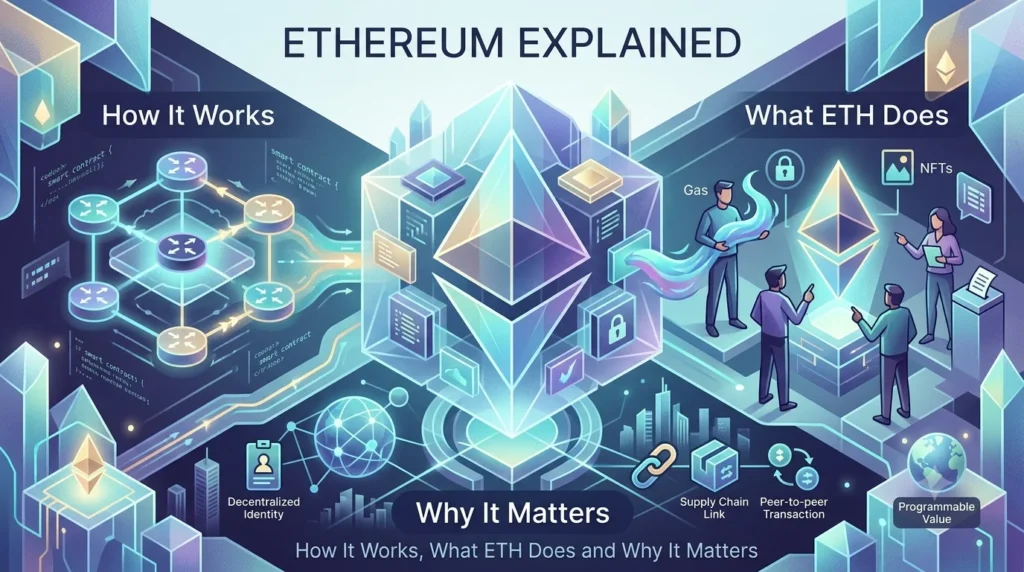
Ethereum Explained: How It Works, What ETH Does and Why It Matters.
Introduction
Cryptocurrency is often associated with digital money and investment, but some blockchain networks are designed to do much more than transfer value between people. Ethereum is one of the best-known examples. It provides a platform on which developers can build applications, create digital assets and run programs without relying entirely on a central organisation to maintain the underlying system.
Ethereum has become an important part of the wider blockchain ecosystem because it supports smart contracts, decentralised finance applications, digital collectibles and other blockchain-based services. Its native cryptocurrency, Ether (ETH), helps pay for network activity and plays a role in securing the system.
However, understanding Ethereum requires more than knowing its token price. The network, the ETH cryptocurrency, the applications built on it and the investment opportunities associated with it are related but different things.
Ethereum is a decentralised blockchain platform that enables people to transfer digital assets and run smart contracts, while Ether (ETH) is its native cryptocurrency. ETH is used to pay transaction fees and support the network’s proof-of-stake security system. Its market price, however, can fluctuate substantially.
This guide explains how Ethereum works, what makes it different from Bitcoin, where it is used, how staking operates and which risks beginners should understand before interacting with the network or purchasing ETH.
Quick Answer: What Is Ethereum?
Ethereum is a blockchain network that supports digital transactions and programmable applications. Its shared database records transactions and application activity, while its execution environment processes instructions from smart contracts.
| Question | Short answer |
|---|---|
| What is Ethereum? | A blockchain platform for transactions and programmable applications |
| What is ETH? | Ethereum’s native cryptocurrency, Ether |
| What is ETH used for? | Transaction fees, transfers, staking and other blockchain activities |
| What are smart contracts? | Programs that execute according to rules written into their code |
| Does Ethereum use mining? | No; its main network uses proof of stake |
| Can ETH be staked? | Yes, through different staking methods with different requirements and risks |
| Is Ethereum the same as Bitcoin? | No; both use blockchains, but their primary designs and capabilities differ |
| Is ETH a guaranteed investment? | No; its price can rise or fall substantially |
| Can Ethereum applications be risk-free? | No; applications, wallets and transactions can expose users to technical and financial risks |
1. What Is Ethereum?
Ethereum is a decentralised blockchain platform designed to support transactions and applications. Instead of serving only as a record of cryptocurrency transfers, it also provides an environment where developers can deploy programs that operate according to predefined rules.
A blockchain is a shared digital record maintained by a network of computers. Transactions are grouped into blocks, and cryptographic links connect those blocks to earlier records. Network participants verify activity according to the protocol’s rules.
Ethereum extends this concept by allowing its blockchain to maintain the state of programmable applications. These applications can manage digital assets, execute financial operations or provide services through smart contracts.
A brief history of Ethereum
Ethereum was proposed by Vitalik Buterin in 2013. The network launched in 2015, introducing a general-purpose blockchain environment for developers.
One of its major milestones occurred on 15 September 2022, when Ethereum completed an upgrade known as The Merge. This changed the network’s consensus mechanism from proof of work to proof of stake.
The change removed the need for Ethereum’s main network to rely on energy-intensive proof-of-work mining for consensus. It also established staking as a central part of the network’s security model.
What makes Ethereum different?
Ethereum’s programmability is one of its defining characteristics.
Developers can create smart contracts that define how transactions and digital assets behave. Other applications can interact with these contracts, allowing more complex services to operate on a shared blockchain.
For example, a decentralised exchange can use smart contracts to facilitate token swaps. A digital collectibles marketplace can interact with contracts that record ownership and transfers.
These capabilities make Ethereum a platform for building applications rather than simply a cryptocurrency used for payments.
2. How Does Ethereum Work?
Ethereum combines a blockchain, a transaction-processing environment and a consensus mechanism. Each part performs a different function.
Blockchain and network participants
Ethereum’s blockchain records transactions and changes to the network’s state. Computers called nodes participate in maintaining and verifying the network according to its rules.
When a user sends ETH or interacts with a smart contract, the transaction is submitted to the network. Nodes check whether it is valid, including whether the transaction has been properly authorised and whether the sender has sufficient funds for the relevant costs.
Valid transactions can then be included in blocks.
Validators and proof of stake
Ethereum uses proof of stake to help participants agree on the blockchain’s valid history.
Validators deposit ETH as stake and operate validator software. They participate in proposing blocks, checking other blocks and attesting to the network’s state.
The system includes rewards for appropriate participation and penalties for certain failures or dishonest behaviour. In serious cases of protocol violations, a validator can lose part of its staked ETH.
Running an independent Ethereum validator requires technical knowledge, suitable infrastructure and the required stake. Users who do not want to operate a validator may explore other staking arrangements, although these introduce additional risks.
You can learn more in Ethereum’s official proof-of-stake documentation.
The Ethereum Virtual Machine
The Ethereum Virtual Machine (EVM) is the execution environment used to process smart-contract instructions.
Developers deploy programs to the network, and users submit transactions that interact with them. Network participants execute and verify the resulting state changes according to Ethereum’s rules.
This shared execution environment allows applications to operate on common infrastructure. However, executing computation consumes network resources, which is why transactions that use Ethereum’s main network generally require gas fees.
Why decentralisation matters
A decentralised network distributes participation across multiple independent operators rather than relying on a single company to maintain the entire system.
This design can make it harder for one organisation to control the network unilaterally. Nevertheless, decentralisation does not eliminate every risk. Software bugs, concentrated infrastructure, governance disputes and application-level vulnerabilities can still affect users.
Ethereum’s security therefore depends on both its protocol design and the behaviour of the people and organisations interacting with it.
3. What Is ETH, and How Is It Different From Ethereum?
The terms Ethereum and ETH are often used interchangeably in casual conversation, but they refer to different things.
Ethereum is the blockchain network and its supporting technology. Ether, represented by the ticker ETH, is the native cryptocurrency used within that ecosystem.
Main uses of ETH
ETH has several important functions.
Paying transaction fees: Users generally pay for transactions and smart-contract execution on Ethereum’s main network using ETH.
Transferring value: People can send ETH between compatible blockchain addresses without requiring a traditional bank transfer to record the transaction on the blockchain.
Supporting network security: Validators stake ETH to participate in proof of stake.
Interacting with applications: ETH can be used in applications that support it, including some decentralised finance services and blockchain-based marketplaces.
These functions connect the cryptocurrency to the network’s operation, although ETH’s market value is determined by trading activity and broader market conditions.
Is ETH the same as a token built on Ethereum?
No. ETH is the network’s native asset, while other tokens can be created through smart contracts deployed on Ethereum.
For instance, a project may issue a token that follows a recognised token standard. That token can exist on Ethereum without becoming the network’s native cryptocurrency.
This distinction matters when sending assets, reviewing transaction fees or checking wallet balances. A token that uses Ethereum infrastructure is not necessarily ETH.
Does ETH have a fixed maximum supply?
Ethereum does not have the same fixed maximum supply rule commonly associated with Bitcoin’s 21-million-coin limit.
ETH issuance and destruction are governed by Ethereum’s protocol. New ETH is issued to support network participation, while a portion of transaction base fees is burned. The balance between issuance and burning affects the overall supply over time.
As a result, ETH supply dynamics depend on network activity and protocol rules rather than a single fixed supply cap.
4. What Are Smart Contracts?
Smart contracts are programs stored and executed on a blockchain. They follow rules written in code and can perform actions when transactions call them with the required information.
The word contract can be misleading because a smart contract is not automatically a legally enforceable agreement. It is software that executes programmed logic.
How smart contracts work
Imagine a simple digital exchange application.
A user submits a transaction requesting a token swap. The application calls the relevant smart contract, which checks the conditions defined in its code and processes the operation if the requirements are satisfied.
The resulting state changes are recorded through Ethereum’s transaction system.
Because the contract’s execution follows code, users can inspect its published logic when the code is verified and available. However, reading code does not always make it easy to understand every risk, particularly when contracts depend on external services or interact with other contracts.
Examples of smart-contract applications
Smart contracts can support several types of applications.
- Decentralised finance: Applications that facilitate lending, borrowing, trading or other financial operations.
- Digital collectibles: Contracts that represent and manage ownership records for certain digital items.
- Decentralised exchanges: Services that use blockchain-based logic to facilitate token trading.
- Blockchain games: Applications that incorporate digital assets or on-chain game mechanics.
- Decentralised organisations: Systems that use smart contracts to support voting, treasury management or other shared processes.
The actual capabilities depend on each application’s design and implementation.
Are smart contracts always safe?
No. Smart contracts can contain programming errors, insecure assumptions or vulnerabilities that attackers exploit.
Even when a contract works exactly as written, its design may produce an outcome that users did not expect. Transactions can also interact with external protocols, price feeds or other services that introduce additional points of failure.
Before using a smart-contract application, research its purpose, permissions, security history and the risks associated with depositing assets.
5. What Is Ethereum Used For?
Ethereum supports a range of activities, from basic transfers to applications that manage digital assets and financial operations.
Digital payments and transfers
ETH can be transferred between compatible addresses. The blockchain provides a public record of the transaction, allowing users to verify activity through a block explorer.
However, blockchain transfers differ from conventional bank payments. An incorrect address or an unsupported network can result in lost funds, and a confirmed transaction generally cannot be reversed simply by contacting a central administrator.
Decentralised finance
Decentralised finance, often shortened to DeFi, refers to financial applications that use blockchain infrastructure and smart contracts.
Depending on the application, users may exchange tokens, supply assets to lending protocols or participate in other financial activities.
These services can operate without some traditional intermediaries, but they are not risk-free. Smart-contract failures, market volatility, liquidation rules and weaknesses in external systems can lead to losses.
NFTs and digital ownership
Non-fungible tokens (NFTs) are blockchain-based tokens designed to distinguish individual assets.
Ethereum has supported NFT marketplaces and projects involving digital art, collectibles, membership access and other uses. However, owning an NFT does not automatically grant copyright or unrestricted commercial rights to the associated content. Those rights depend on the applicable licence and legal arrangements.
Tokenisation
Tokenisation involves representing certain assets or rights through digital tokens.
Ethereum-based systems can be used to create tokens representing various kinds of interests or assets. The legal meaning of those tokens depends on their structure, the issuer and the relevant jurisdiction.
A blockchain record alone does not guarantee that a real-world asset exists, that ownership is legally recognised or that the token can be redeemed.
Blockchain-based applications
Developers can build applications that use Ethereum’s shared infrastructure rather than maintaining every component independently.
This can support marketplaces, games, digital identity experiments, coordination tools and other services. The user experience may still depend on conventional websites, servers or third-party infrastructure.
Ethereum is therefore best understood as one part of a broader technology ecosystem, not a guarantee that every application built on it is decentralised or reliable.
6. What Are Gas Fees on Ethereum?
Gas is the unit used to measure the computational work required to execute operations on Ethereum.
A transaction’s fee depends on how much gas it uses and the price paid per unit of gas. Simple transfers generally require less computation than complex smart-contract interactions, although the exact fee varies with the transaction and network conditions.
How gas fees are calculated
On Ethereum’s main network, the fee is generally based on the amount of gas used multiplied by the effective price per unit of gas.
The transaction fee includes a base fee and may include an additional priority fee, also called a tip.
The base fee is burned, meaning it is removed from circulation. The priority fee goes to the validator who includes the transaction, subject to the network’s transaction rules.
Why do gas fees change?
Gas fees can rise when demand for block space increases.
If many users want transactions processed at the same time, they may compete by offering higher priority fees. During quieter periods, the cost of executing a comparable transaction may be lower.
The complexity of the operation also matters. A smart contract that performs multiple calculations or changes several pieces of state may use more gas than a basic ETH transfer.
How to manage transaction costs
Consider these precautions before submitting a transaction:
- Review the estimated fee in your wallet.
- Confirm that the transaction is being sent on the intended network.
- Understand whether you are interacting with a contract or making a simple transfer.
- Check the transaction details before signing.
- Avoid repeatedly submitting transactions without understanding the reason for a failure.
Some applications use Ethereum layer-2 networks, which process transactions using additional infrastructure and may offer different cost and performance characteristics. Fees, security assumptions and withdrawal arrangements vary between networks, so check the details before moving assets.
7. How Does Ethereum Staking Work?
Staking is part of Ethereum’s proof-of-stake security system. Participants deposit ETH and take part in validating the network, following the protocol’s requirements.
In return, eligible validators can receive rewards for correct participation. However, staking is not a guaranteed income product, and different methods involve different costs and risks.
Running your own validator
Operating an independent validator requires a minimum deposit of 32 ETH under the standard validator setup, along with suitable hardware, software and ongoing maintenance.
The validator must remain sufficiently reliable and follow protocol rules. Downtime can reduce rewards, while certain forms of misconduct can lead to more severe penalties.
This method offers direct participation but requires technical responsibility and exposure to validator-related risks.
Staking through a provider or pool
People with less than 32 ETH, or those who do not want to maintain a validator, may consider staking pools or third-party providers.
These services can lower the practical barrier to participation. Nevertheless, they may introduce smart-contract risk, operator risk, custody risk, fees or additional withdrawal conditions.
A pooled service is not the same as running an independent validator, and its advertised rewards should not be treated as guaranteed returns.
Liquid staking
Some services issue a separate token representing a user’s claim associated with staked ETH.
Such tokens may be transferable or usable in other applications, depending on their design. However, they can trade at a different price from ETH and may introduce additional protocol, liquidity and smart-contract risks.
What should you consider before staking?
Review the following points before committing funds:
- The method used to stake and who controls the keys.
- The provider’s fees and operating model.
- The possibility of penalties or technical failures.
- Withdrawal and exit arrangements.
- Any additional risks created by liquid staking or restaking.
- Your ability to tolerate price changes in ETH.
For current technical details, consult the official Ethereum staking guide.
8. Ethereum vs Bitcoin: What Is the Difference?
Ethereum and Bitcoin are both prominent blockchain networks, but they were designed with different priorities.
Bitcoin focuses primarily on peer-to-peer digital value transfer and a monetary system with a protocol-defined maximum supply. Ethereum was designed to support programmable applications alongside transfers of its native asset.
| Feature | Ethereum | Bitcoin |
|---|---|---|
| Native asset | Ether (ETH) | Bitcoin (BTC) |
| Primary design | Programmable blockchain and digital asset network | Peer-to-peer digital currency and settlement network |
| Consensus mechanism | Proof of stake | Proof of work |
| Smart contracts | Supports general-purpose smart-contract execution | Supports scripting, with different design and capabilities |
| Network participation | Validators stake ETH | Miners use proof of work |
| Native asset supply | No fixed maximum supply cap in the same sense as Bitcoin | Maximum supply defined at 21 million BTC |
| Common uses | DeFi, smart contracts, tokens and transfers | Value transfer, settlement and investment |
| Transaction fees | Gas-based fees | Transaction fees based on transaction and block-space conditions |
Which one is better?
Neither is universally better for every purpose.
A developer building a smart-contract application may find Ethereum’s execution environment suitable. Someone interested in Bitcoin’s monetary design may prefer its specific supply rules and security model.
Both assets can experience substantial price volatility, and their networks have different technical, economic and operational characteristics.
It is more useful to understand the purpose and trade-offs of each network than to assume that one must outperform the other.
9. What Affects the Price of ETH?
ETH’s market price is influenced by multiple factors. No single indicator reliably predicts its future value.
Supply and demand
ETH trades in cryptocurrency markets, where buyers and sellers influence its price.
Demand can change as people use Ethereum applications, trade digital assets or respond to broader financial conditions. Supply dynamics are also affected by issuance, fee burning and changes in staking participation.
These factors can interact in complex ways, so increased network activity does not guarantee an increase in ETH’s price.
Network adoption
Interest in decentralised applications, tokenisation, stablecoins and other Ethereum-based services may affect demand for network resources and ETH.
However, activity can be distributed across the main network and layer-2 systems. The relationship between adoption, fees and the market price is not straightforward.
Broader cryptocurrency sentiment
ETH can be affected by developments across the wider crypto market, including Bitcoin price movements, investor risk appetite, liquidity and changes in trading activity.
Even when Ethereum-specific developments are positive, wider market conditions can place downward pressure on the price.
Regulation and policy
Regulatory developments can influence exchanges, service providers, staking products and the ways people access digital assets.
The effect depends on the jurisdiction, the specific policy and how businesses and users respond. Regulations may change, so people should consult current official information relevant to their location.
Technology and competition
Network upgrades, competing blockchain platforms, security incidents and changes in user experience can influence perceptions of Ethereum’s usefulness.
Nevertheless, a technical improvement does not automatically produce a corresponding market gain. Investors should separate evidence about network development from speculation about token prices.
10. What Are the Risks of Using or Investing in Ethereum?
Ethereum’s technology enables a variety of activities, but participation involves financial, technical and security risks.
Price volatility
ETH can rise or fall substantially over short periods. Anyone purchasing it may lose some or all of the amount invested.
Do not assume that historical performance, popular commentary or network growth guarantees future returns.
Wallet and private-key security
A cryptocurrency wallet helps users manage keys and interact with blockchain addresses. The security of those keys is essential.
If someone gains access to your private key or recovery phrase, they may be able to transfer your assets. Lost keys may also make funds inaccessible.
Never share your recovery phrase with someone claiming to provide support, and be wary of websites asking you to enter it.
Scams and impersonation
Fraudsters may impersonate exchanges, wallet providers, developers or technical support teams.
Common warning signs include guaranteed returns, urgent payment requests, unsolicited investment offers and demands for private keys.
Use independently verified websites and consult Ethereum’s official security guidance before interacting with unfamiliar services.
Smart-contract vulnerabilities
An application built on Ethereum can contain bugs even when the underlying blockchain continues operating normally.
A vulnerability may allow an attacker to exploit the application, manipulate its behaviour or steal assets held by a contract.
Research the application and understand what permissions you are granting before approving transactions.
Transaction mistakes
Blockchain transfers can be difficult or impossible to reverse once confirmed.
Check the recipient address, asset, amount and network carefully. A token sent through an incompatible network or to an incorrect address may be difficult to recover.
Staking and provider risks
Staking can involve penalties, operational problems, provider failures and withdrawal restrictions. Liquid staking and restaking can add further dependencies.
Read the relevant terms and understand the risks before committing ETH.
Regulatory and tax obligations
Tax treatment and regulatory requirements vary by jurisdiction and transaction type.
Buying, selling, exchanging or staking digital assets may have tax consequences. Seek advice from a qualified professional who understands the rules applicable to your circumstances.
Important: This article is educational and does not constitute financial, tax or legal advice. Research independently and never invest money you cannot afford to lose.
11. How Beginners Can Get Started With Ethereum
A beginner does not need to understand every technical detail before learning how Ethereum works. A careful, step-by-step approach can help reduce avoidable mistakes.
Step 1: Learn the fundamentals
Understand the difference between Ethereum, ETH, wallets, blockchain addresses, gas fees and smart contracts.
These concepts explain what happens when you transfer assets or interact with an application.
Step 2: Choose a wallet carefully
A wallet can be a software application or a hardware device. Different wallets offer different security features and levels of control.
Research the provider, download software only from verified sources and store recovery information securely. Never send your recovery phrase to another person.
Step 3: Understand the network
Ethereum’s main network and compatible layer-2 networks have different transaction environments and fee arrangements.
Before sending funds, verify that the receiving wallet or application supports the selected network and asset.
Step 4: Start with a small test transaction
If you decide to transfer cryptocurrency, consider testing the process with a small amount first, while accounting for transaction fees.
Verify the destination address and review the transaction details before confirming. A test transfer does not eliminate risk, but it may help reveal basic mistakes before a larger transfer.
Step 5: Research platforms before buying ETH
If you decide to purchase ETH, investigate the platform’s identity, fees, security practices, withdrawal rules and regulatory status in your jurisdiction.
Compare the total costs rather than looking only at the advertised trading fee.
Step 6: Keep records and monitor security
Maintain records of transactions for personal accounting and any applicable tax obligations.
Review wallet activity, use appropriate device security and be cautious with unfamiliar links or token approvals. Regularly learning about new scams can help you protect your assets.
Step 7: Separate learning from investing
You can learn about Ethereum’s technology without purchasing ETH.
If you later consider investing, assess your financial position, risk tolerance and investment goals independently. A strong understanding of the technology does not remove market risk.
12. Final Thoughts
Ethereum is more than a cryptocurrency. It is a programmable blockchain network that supports digital transfers, smart contracts and a wide range of applications. Ether (ETH) is central to this ecosystem because it pays for network activity and supports proof-of-stake security.
Understanding the difference between the platform and its native asset is an important first step. From there, concepts such as gas fees, validators, smart contracts and decentralised applications help explain how Ethereum works and why people use it.
At the same time, the technology has limitations. Transaction mistakes can be difficult to reverse, applications may contain vulnerabilities, staking arrangements involve risks and ETH’s market price can fluctuate significantly.
For beginners, the most useful approach is to learn the fundamentals, verify information through reliable sources, protect wallet credentials and avoid making financial decisions based solely on market predictions.
Ethereum offers a flexible foundation for blockchain-based applications, but informed participation requires understanding both its capabilities and its risks.
What is Ethereum in simple words?
Ethereum is a blockchain network that allows people to transfer digital assets and run applications through smart contracts. ETH is its native cryptocurrency, used for transaction fees, staking and other network activities.
Is Ethereum a cryptocurrency or a blockchain?
Ethereum is the blockchain platform, while Ether (ETH) is its native cryptocurrency. People often use the word Ethereum when they mean ETH, but the two terms describe different things.
What is ETH used for?
ETH is used to pay gas fees, transfer value, participate in staking and interact with applications that support it. Its market price also fluctuates as people trade it on cryptocurrency markets.
Is Ethereum the same as Bitcoin?
No. Bitcoin uses proof of work and has a protocol-defined maximum supply of 21 million BTC. Ethereum uses proof of stake and supports a broader general-purpose smart-contract environment. Both involve financial and technical risks.
Can you mine Ethereum?
Ethereum’s main network no longer uses proof-of-work mining for consensus. It switched to proof of stake in September 2022. Validators now help secure the network by staking ETH and participating in consensus.