
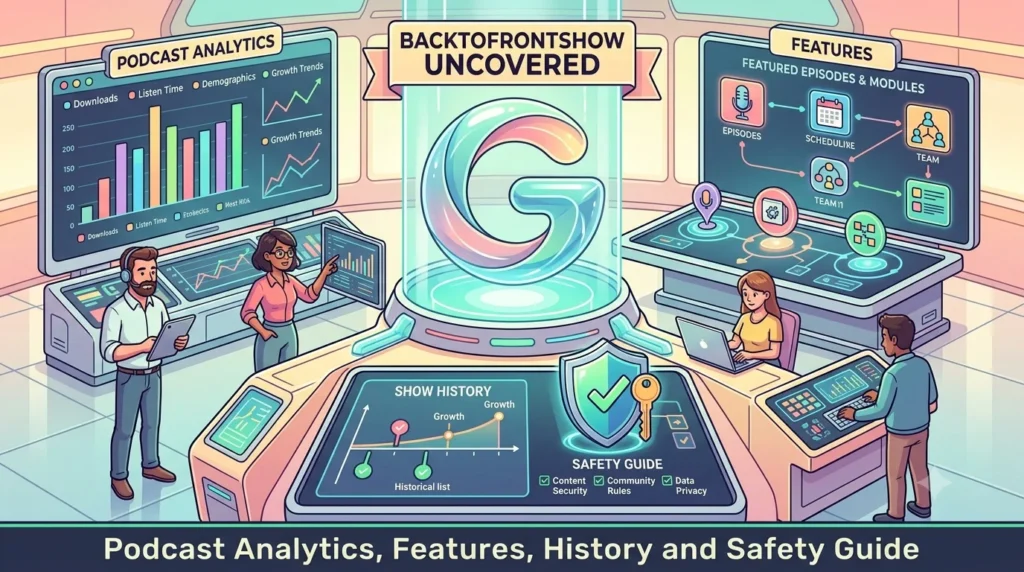
BacktoFrontShow Uncovered: Podcast Analytics, Features, History and Safety Guide.
Introduction
Finding the right information about an unfamiliar website can be challenging, particularly when the same name appears across different websites and online articles. BacktoFrontShow is one example. Searching for this term may lead you to pages discussing podcast analytics, audience engagement, customised reporting and the history of an earlier podcast.
Understanding these different references is important before deciding whether the website is relevant to your interests or professional needs. A page describing a service does not automatically establish how well that service works, while an article repeating its advertised features does not independently verify those claims.
The current website, BacktoFrontShow.com, presents itself as a podcast analytics platform. Its homepage promotes audience demographics, listening behaviour, engagement metrics, device information, geographical insights and customised reports. The name is also associated with an earlier web-industry podcast known as The Back to Front Show.
BacktoFrontShow is a name associated with podcast analytics services and an earlier web-industry podcast. Anyone researching the platform should distinguish its advertised features from independently verified information.
This guide explains what BacktoFrontShow claims to offer, how podcast analytics can help creators, what its advertised features might be useful for, and which questions to investigate before requesting access or paying for a service.
Quick Answer: What Is BacktoFrontShow?
BacktoFrontShow.com currently presents itself as a platform intended to help podcasters and media teams understand listener behaviour beyond basic download numbers.
| Question | Short answer |
|---|---|
| What is BacktoFrontShow? | A website that currently advertises podcast analytics services |
| What features does it promote? | Audience demographics, listening behaviour, engagement, device data and geographical insights |
| Who might find it useful? | Podcasters, media teams and organisations that analyse podcast performance |
| Does it offer reporting? | The website advertises customised reports and an analytics dashboard |
| Is it connected to a podcast? | The name is also associated with an earlier web-industry podcast |
| Is the service independently verified? | Its advertised capabilities should be checked before relying on them |
| Should you check pricing? | Yes. Confirm current prices, access terms and deliverables directly |
| Is it safe to submit information? | Evaluate the privacy policy, provider identity, access requirements and payment terms first |
The distinction between advertised features and independently verified capabilities is essential when researching a relatively unfamiliar online service.
1. What Is BacktoFrontShow?
BacktoFrontShow is the name of a website that currently markets tools for understanding podcast audiences and performance.
According to its official homepage, the platform aims to provide more detailed information than a simple count of episode downloads. Its advertised features focus on audience characteristics, listening behaviour, engagement and reporting.
For podcast creators, this type of information can be valuable. Knowing that an episode received a particular number of downloads provides only one part of the picture. Understanding when listeners engage, which episodes perform well and where an audience is located can help creators evaluate their content strategy.
However, it is important to distinguish the general value of podcast analytics from the verified performance of a particular provider. The fact that a website advertises a feature does not independently establish its accuracy, availability or effectiveness.
What problem does BacktoFrontShow aim to address?
Podcast creators often need answers to questions such as:
- Which episodes attract the most listeners?
- Where are listeners located?
- Which devices do people use to access episodes?
- How does engagement change between episodes?
- Which topics appear to attract a stronger response?
- What information should be included in a performance report?
BacktoFrontShow’s website presents its analytics and reporting features as a way to investigate these questions.
The usefulness of any analytics platform depends on the data it can legitimately access, how it processes that information and whether its reports help users make better decisions.
Is BacktoFrontShow a podcast or a software platform?
The answer depends on which reference you encounter.
The current BacktoFrontShow.com homepage describes an analytics service. Meanwhile, another website, Back to Front Show Podcast, describes a podcast focused on conversations, interviews and stories.
Historical material also associates the name with a web and technology podcast. These references should not automatically be treated as evidence that every website using a similar name belongs to the same organisation.
When researching BacktoFrontShow, begin with the exact domain and check which service or publication you are viewing.
2. Why Is BacktoFrontShow Being Searched Online?
People search for unfamiliar website names for several reasons. They may want to understand a product, compare available services, investigate pricing or determine whether a website is trustworthy.
BacktoFrontShow presents several potential research questions because its name appears in different online contexts.
People want to understand the platform
Someone who discovers BacktoFrontShow may first want a straightforward explanation of its purpose.
In this case, the current website positions itself around podcast analytics. It advertises tools intended to help users examine listener information, engagement and content performance.
That description provides a starting point, although prospective users should confirm the actual capabilities during a demonstration or evaluation.
Creators may be exploring analytics tools
Podcasting involves more than recording and publishing episodes. Creators may also need to measure audience growth, understand listening patterns and evaluate promotional activities.
An analytics service could potentially help organise those measurements into a more useful format.
Nevertheless, users should compare the platform’s data sources, reporting options and costs with the tools they already have before deciding whether another subscription is necessary.
Users may be investigating the name’s history
The earlier Back to Front Show podcast creates another reason for searches. Someone looking for historical episodes or information about the original programme may encounter pages promoting a different service.
Checking the domain, publication date, author information and links to primary sources can help separate historical material from current product descriptions.
Search results can contain conflicting information
Not every online article about a platform is based on direct testing or independent research. Some pages repeat information from other articles, while others make claims that are difficult to verify.
For this reason, use the official website to identify what a provider advertises, then look for independent evidence before relying on claims about customer results, data accuracy or commercial performance.
3. Main Features Advertised by BacktoFrontShow
BacktoFrontShow promotes several categories of podcast analytics. The following sections explain what those features are intended to do and what prospective users should verify.
Audience demographics
The website advertises demographic insights intended to help users understand the characteristics of their listeners.
Depending on the data source and collection method, demographic reporting may provide information about audience segments. However, not every podcast platform can reliably identify a listener’s age, interests or other personal characteristics.
Before relying on these reports, ask how demographic information is obtained, whether it is observed or estimated, and how much of the audience it represents.
Listening behaviour
Listening-behaviour analysis can help creators understand patterns in audience activity.
For example, a useful analytics report might show when people listen, how episode performance changes over time or whether certain content formats attract more sustained attention.
BacktoFrontShow advertises listening-behaviour insights, but the exact metrics available and their measurement methods should be confirmed directly with the provider.
Engagement metrics
The platform also promotes engagement analysis involving interactions such as likes, shares and comments.
These indicators can help creators assess how people respond to content, provided the underlying data is available and measured consistently.
However, engagement is not the same as listening time or audience retention. A person might listen to an entire episode without leaving a comment, while another might share a clip after hearing only a small portion.
A reliable assessment should therefore consider several relevant metrics rather than relying on a single engagement figure.
Device analytics
Device analytics can help show how audiences access content, such as through different device categories or listening environments.
This information may support decisions about accessibility, audio quality and promotional formats.
Before choosing a platform, verify which devices, applications and podcast distribution services it supports. Also ask whether the information covers all listeners or only activity that can be measured through connected systems.
Geographical analytics
BacktoFrontShow advertises geographical reporting intended to help users understand where their audiences are located.
For a creator targeting a particular market, location information can help guide promotional planning and content scheduling.
Nevertheless, location data may be approximate or incomplete. A reporting tool should explain how it determines location and whether its figures represent individual listeners, downloads or another measurement.
Custom reports and dashboards
The website also promotes a dashboard and customised reporting.
A dashboard can make information easier to review, while custom reports may help teams present relevant findings to clients, managers or commercial partners.
The practical value depends on whether users can select useful metrics, export reports in suitable formats and connect the information to their existing workflow.
Review a sample report before committing to a subscription. That step can reveal whether the presentation is clear enough for your actual reporting needs.
4. How Podcast Analytics Works
Podcast analytics generally involves collecting available performance data, organising it into meaningful measurements and presenting the results through reports or dashboards.
The precise process varies by provider. BacktoFrontShow describes a workflow involving podcast integration, data collection, dashboard analysis and customised reporting.
Step 1: Connect a podcast or data source
An analytics service first needs access to relevant information.
Depending on the platform, this may involve connecting a podcast hosting account, importing reports or integrating with supported services. The available methods determine which information can be analysed.
Before granting access, check the permissions requested. A tool should not require broader account access than is reasonably necessary for its stated purpose.
Step 2: Collect available data
The service gathers information from its supported sources.
The resulting dataset may include downloads, episode performance, listening patterns or other available measurements. The scope of that information depends on the source and the technical limitations of the integration.
It is worth asking whether the provider receives raw data, aggregated statistics or estimates derived from other measurements.
Step 3: Organise information into metrics
Analytics software processes the available information and displays selected indicators.
For example, a creator might compare episode performance across a chosen period or examine changes in audience activity. Such comparisons are most useful when the underlying definitions remain consistent.
If a provider changes how it calculates a metric, comparisons across different periods may become less meaningful.
Step 4: Interpret results and make decisions
The final step is to use the information to improve planning.
A creator might investigate why one topic performed better than another, adjust a promotional schedule or test a different episode format.
Analytics can inform these decisions, but it cannot guarantee that a particular change will increase audience growth or revenue. Results should be evaluated over time rather than attributed to one metric alone.
5. Who Might Benefit From Podcast Analytics?
Podcast analytics can serve different needs depending on the size of a production, its goals and the complexity of its reporting requirements.
Independent podcasters
Independent creators may want to understand which episodes attract attention and whether their audience is growing.
A simple dashboard may be enough for a small show. More advanced reporting becomes useful when the creator manages multiple programmes, campaigns or distribution channels.
Before paying for a specialist service, compare its capabilities with the statistics already available through your podcast host.
Podcast networks
Networks managing several shows may need consistent reports across different programmes.
A central reporting system can make it easier to compare episode performance and identify broad trends. However, comparisons should account for differences in publishing schedules, episode length, subject matter and audience size.
A platform is more useful when its reporting structure supports those differences instead of treating every show as identical.
Marketing agencies
Agencies may need to report podcast campaign results to clients.
Relevant measurements can include episode performance, audience geography and available engagement indicators. The appropriate metrics depend on the campaign’s goals and what the data source can reliably measure.
Agencies should also verify whether reports can be exported, branded and shared securely with clients.
Media companies
Media organisations may have more complex reporting needs, particularly when they manage multiple content brands.
They may benefit from custom dashboards, consistent measurement definitions and integrations with existing reporting systems.
Even so, an enterprise-oriented feature list does not automatically make a service suitable for a large organisation. Security, scalability, contractual terms and support arrangements also require evaluation.
6. BacktoFrontShow Pricing and Access
Pricing is an important consideration when comparing analytics platforms.
The BacktoFrontShow website has displayed paid plans, including a Basic plan advertised at $1,200 per month and a Pro plan advertised at $3,600 per month. Enterprise pricing is presented as available on request. These figures are website-listed prices, not independently verified evidence of a completed sale or the service’s current commercial terms.
What should you check in a pricing plan?
Do not compare subscriptions based only on the number of features listed. Instead, investigate what you will actually receive.
Consider these questions:
- Which analytics features are included in each plan?
- How many podcasts or accounts can you connect?
- Are there limits on data history or report exports?
- Does the subscription include onboarding and technical support?
- Are integrations included or charged separately?
- Is there a minimum contract period?
- What happens when you cancel?
- Are taxes or additional service fees applicable?
These details help you understand the total cost of using a service.
Is BacktoFrontShow worth the price?
That depends on your requirements, budget and the reliability of the product’s capabilities.
A creator who only needs basic download statistics may not benefit from an expensive specialist service. Conversely, an organisation managing numerous shows may be willing to pay more for verified reporting, time savings and useful integrations.
Before subscribing, request a demonstration, review a sample report and ask for written confirmation of the features included in your chosen plan.
If the provider cannot clearly explain its data sources, service limitations or contract terms, consider delaying the purchase until those questions are resolved.
7. BacktoFrontShow and the Earlier Podcast
One reason the name can be confusing is its association with an earlier programme called The Back to Front Show.
Historical material describes the original podcast as focusing on web design, development and the experiences of people working in the digital industry. The Back to Front Show Podcast about page also presents a podcast identity centred on conversations, interviews and stories.
The current BacktoFrontShow.com website, by comparison, promotes analytics tools for podcasters.
Why this distinction matters
A podcast archive and an analytics service have different purposes.
A podcast archive provides access to episodes and related editorial material. An analytics platform is intended to process information about audience or content performance.
They may share a name without sharing the same ownership, technology, business model or operational history.
Consequently, do not assume that information about an older podcast proves the current analytics service is established, nor should a page advertising software be treated as authoritative evidence about the historical programme.
How to research the original show
If your interest is in the earlier podcast, look for episode archives, original descriptions, publication dates and credible historical references.
If your interest is the analytics service, focus on its current documentation, provider identity, product demonstrations, privacy terms and commercial agreements.
Keeping these research paths separate makes it easier to reach an accurate understanding of what you are investigating.
8. Potential Benefits and Limitations
Podcast analytics can be valuable when the information is reliable and directly relevant to a creator’s goals. However, every analytics tool has limitations.
Potential benefits
Better content planning: Episode-level data can help creators identify patterns and develop topics that align with audience interests.
More informed promotion: Geographic and engagement information may help guide promotional decisions where the underlying data supports those uses.
Simplified reporting: A dashboard can reduce the effort involved in gathering statistics from multiple sources.
Performance comparisons: Consistent metrics can help teams evaluate results over time.
More structured decision-making: Data can provide evidence to support content experiments rather than relying entirely on intuition.
These are potential benefits of podcast analytics in general. Whether BacktoFrontShow delivers them effectively depends on its actual implementation and the quality of its data.
Important limitations
Incomplete data: Some listening activity may not be measurable through a particular integration.
Estimated audience information: Demographic or geographic insights may rely on estimates rather than direct observations.
Misleading comparisons: Metrics can be difficult to compare if they use different definitions or reporting periods.
Subscription costs: Advanced reporting may be unnecessary for creators with straightforward needs.
Privacy concerns: Listener information must be collected, processed and retained appropriately.
Unverified product claims: Marketing descriptions alone do not demonstrate accuracy, reliability or customer outcomes.
The most sensible approach is to evaluate the platform using your own requirements and evidence from a demonstration or trial, if one is available.
9. What to Check Before Using BacktoFrontShow
Researching an unfamiliar website does not require assuming that it is unsafe. It means checking the relevant evidence before sharing information or making a financial commitment.
Verify the provider
Look for a clearly identified business, consistent contact information and documentation explaining who operates the service.
You can start with the official BacktoFrontShow contact page. However, a contact page alone does not independently verify a company’s identity or track record.
Where appropriate, check the business details through reliable public records and look for credible independent references.
Read the privacy policy
An analytics platform may handle account information or data related to audience activity.
Review what information is collected, why it is needed, how long it is retained and whether it is shared with other parties. Check whether the policy explains your rights and the available deletion procedures.
If the answers are unclear, ask the provider for clarification before connecting an account.
Check account permissions
Review the access requested during integration.
Where possible, use limited permissions and avoid sharing passwords or recovery credentials directly. If an integration requests access unrelated to the advertised service, ask why that access is necessary.
Confirm pricing and cancellation terms
Request written details about subscription fees, renewal arrangements, cancellation procedures and refunds.
Do not assume that a plan displayed on a website includes every feature mentioned elsewhere on the same domain.
Look for independent evidence
Search for detailed reviews, documented customer experiences and credible discussions that are not simply copies of the provider’s own marketing language.
Be cautious about testimonials that cannot be attributed to identifiable customers or claims that promise unusually large improvements without supporting evidence.
Protect payment information
Use a payment method with appropriate protections and verify the recipient before paying.
Avoid sending money through unusual channels because of pressure to act quickly. A legitimate commercial decision should allow enough time to review the terms and ask questions.
10. BacktoFrontShow vs Traditional Podcast Analytics
BacktoFrontShow’s advertised focus overlaps with the broader purpose of podcast analytics: understanding audience behaviour and measuring content performance.
The important question is not whether a platform offers many features, but whether it provides reliable information that helps you make better decisions.
| Evaluation area | What to look for |
|---|---|
| Basic performance | Reliable download and episode statistics |
| Audience insights | Clear explanations of available demographic and location data |
| Listening behaviour | Defined metrics and transparent measurement methods |
| Reporting | Useful dashboards and export options |
| Integrations | Compatibility with your existing podcast host and workflow |
| Data security | Clear access controls, privacy terms and retention practices |
| Pricing | Transparent fees and understandable contract terms |
| Support | Documented assistance channels and realistic response expectations |
How should you compare analytics platforms?
Start by listing the questions you need your analytics to answer. Then compare providers based on their ability to answer those questions with credible data.
For example, a small creator may prioritise episode downloads and audience trends. An agency may need report exports and client-ready presentations. A network might place greater emphasis on managing multiple shows and maintaining consistent measurement standards.
Use the same criteria to assess every provider. This makes the comparison more meaningful than choosing the service with the longest feature list.
For BacktoFrontShow specifically, request a demonstration and verify the metrics, integrations, privacy controls and pricing that matter to your organisation.
12. Final Thoughts
BacktoFrontShow is worth researching carefully because the name appears in more than one online context. Its current website promotes podcast analytics features, including audience demographics, listening behaviour, engagement measurements, device insights, geographical reporting and customised dashboards. The name is also connected to an earlier web-industry podcast.
For podcast creators, analytics can provide useful information about content performance and audience activity. However, a long feature list does not automatically prove that a platform’s measurements are accurate or that its subscription represents good value.
Before using BacktoFrontShow, verify its current offerings, request a demonstration, examine the data collection methods and read the privacy and payment terms. Compare its capabilities with your existing tools and look for independent evidence that supports its claims.
The key takeaway is simple: understand which BacktoFrontShow website you are researching, separate advertised features from verified evidence, and make decisions based on clear documentation rather than assumptions.
What is BacktoFrontShow?
BacktoFrontShow.com currently presents itself as a podcast analytics platform. It advertises audience insights, listening-behaviour analysis, engagement measurements, device information, geographical reporting and customised dashboards.
What does BacktoFrontShow do?
According to its website, the service aims to help podcast creators and media teams analyse listener-related information and review podcast performance. The exact functionality and data coverage should be confirmed directly with the provider.
Is BacktoFrontShow a podcast?
The name is associated with an earlier web-industry podcast called The Back to Front Show. The current BacktoFrontShow.com homepage, however, promotes podcast analytics services. Check the exact website to determine which reference you are viewing.
How much does BacktoFrontShow cost?
The website has advertised a Basic plan at $1,200 per month, a Pro plan at $3,600 per month and Enterprise pricing on request. These prices should be treated as advertised figures and confirmed directly before purchasing.
Who can use BacktoFrontShow?
Its advertised audience includes podcasters and media teams that want to understand listening activity and audience characteristics. Whether it suits an individual creator, agency or larger organisation depends on the available features, costs and data requirements.