
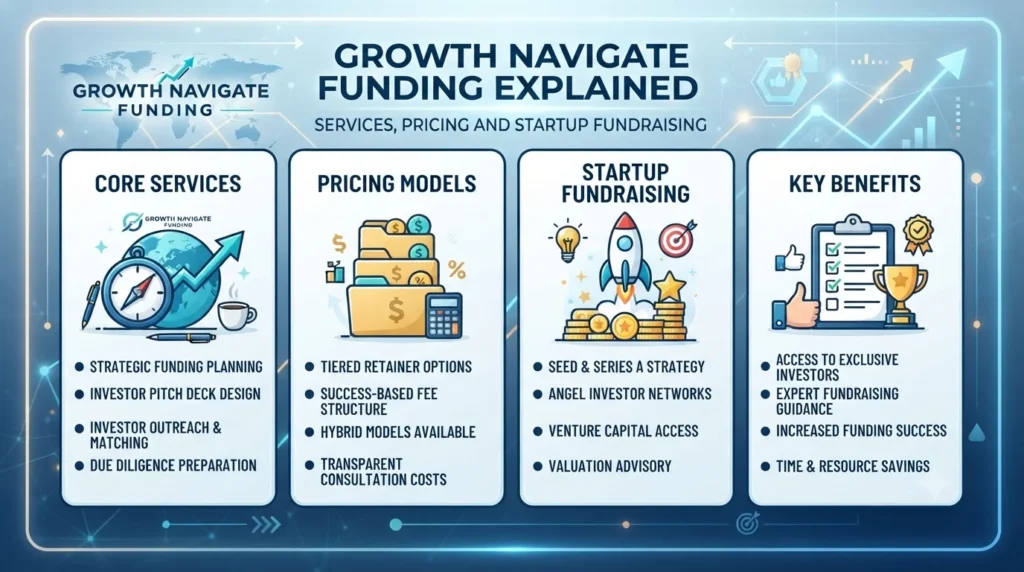
Growth Navigate Funding Explained: Services, Pricing and Startup Fundraising.
Introduction
Raising capital is one of the biggest challenges facing startups and growing companies. Founders need more than a good business idea. They also need a clear fundraising strategy, financial projections, investor materials, target investors and a process for handling due diligence.
Growth Navigate Funding presents itself as a startup fundraising advisory firm designed to support founders through those stages. Its official website says it works with companies from pre-seed through Series C and provides services including fundraising strategy, pitch-deck development, investor relations, financial modeling, growth strategy and due-diligence preparation.
The company also publishes figures about its claimed experience, including $450 million+ in capital secured, 300+ startups funded and a network of 1,000+ investor relationships. These are company-reported figures rather than independently verified statistics, so they should be treated accordingly.
There is another reason to research the name carefully. Several similarly named websites exist online, including GrowthNavigate.com and GrowthNavigateFunding.net. Their services and published information are not necessarily evidence about the exact company operating GrowthNavigateFunding.com.
This guide explains what Growth Navigate Funding says it offers, how its fundraising process works, what pricing is publicly displayed, what founders should verify before engaging an advisory firm, and how the service differs from obtaining capital directly from investors or lenders.
Quick Answer: What Is Growth Navigate Funding?
Growth Navigate Funding is a startup fundraising advisory service that says it helps founders prepare for and execute capital raises.
According to its official website, the company supports startups from pre-seed through Series C and offers several fundraising-related services. These include:
- Fundraising strategy
- Pitch-deck development
- Investor relations and network access
- Financial modeling
- Growth strategy
- Due-diligence preparation
- Cap-table and equity strategy
- Market-entry and expansion advisory
The company says it has helped more than 300 startups and that its network includes more than 1,000 active investors. Those figures are self-reported by Growth Navigate Funding and should not be interpreted as independently verified performance data.
The official services page currently displays three advisory packages:
- Launchpad — $4,500/month
- Navigator — $9,500/month
- Ascent — custom pricing
Pricing can change, so prospective clients should confirm the current commercial terms directly before signing an agreement.
Growth Navigate Funding at a Glance
| Factor | Current information |
|---|---|
| Business name | Growth Navigate Funding |
| Exact domain reviewed | GrowthNavigateFunding.com |
| Business type | Startup fundraising advisory |
| Target clients | Startups and founders |
| Funding stages | Pre-seed through Series C |
| Core services | Fundraising strategy, pitch decks, investor access, financial modeling and due diligence |
| Reported investor relationships | 1,000+ |
| Company-reported startups funded | 300+ |
| Company-reported capital secured | $450M+ |
| Published Launchpad price | $4,500/month |
| Published Navigator price | $9,500/month |
| Ascent | Custom pricing |
| Initial consultation | Free 30-minute strategy consultation |
| Important consideration | Company claims should be distinguished from independently verified results |
What Is Growth Navigate Funding?
Growth Navigate Funding positions itself as a capital advisory partner for startups.
The company says its role extends beyond simply introducing founders to investors. Its stated services cover the preparation, positioning and management of a fundraising process.
That includes understanding the startup’s funding stage, preparing investor materials, developing financial models, identifying potential investors, coordinating outreach and helping with due diligence.
According to the company’s About page, Growth Navigate Funding says it was founded in 2013 and has offices in New York and San Francisco. The same page states that its founders spent more than a decade working inside venture-backed companies and investment firms before establishing the advisory practice.
These are statements published by the company itself. Readers researching the business should distinguish those claims from information independently confirmed through external corporate or regulatory records.
What Services Does Growth Navigate Funding Offer?
Growth Navigate Funding currently lists a relatively broad collection of fundraising and growth-advisory services.
The main offering can be divided into several stages.
1. Fundraising Strategy and Roadmaps
The first stage is strategic planning.
Growth Navigate Funding says it creates funding roadmaps based on factors such as:
- Startup stage
- Sector
- Investor landscape
- Funding requirements
- Valuation considerations
- Fundraising timeline
- Competitive positioning
The official services page says the strategy work can cover companies from pre-seed through Series C and includes investor targeting, funding-range analysis, investment-thesis development and fundraising milestones.
For founders, this type of planning can help answer a basic question:
How much capital should the company seek, from whom, and for what business milestones?
A fundraising strategy should ideally connect the requested capital to measurable objectives rather than simply choosing a large round because more cash appears attractive.
2. Pitch Deck Development
Investor presentations are another core service.
Growth Navigate Funding says it develops investor-facing pitch decks that can include:
- Company story
- Market opportunity
- Competitive landscape
- Financial information
- Team
- Traction
- Use of funds
- Market sizing
The services page describes a full 12–15 slide deck architecture along with design, data visualization, an executive summary and teaser-deck variations.
A pitch deck is important because it provides an investor with a concise explanation of the business.
However, good design alone cannot compensate for weak fundamentals.
Investors may still examine:
- Revenue
- Customer acquisition
- Retention
- Unit economics
- Market size
- Competitive differentiation
- Management experience
- Cash position
- Growth assumptions
Therefore, founders should view the deck as a communication tool rather than the investment itself.
3. Investor Relations and Network Access
Growth Navigate Funding also markets access to its investor network.
The company says it maintains relationships with 1,000+ active investors, including:
- Venture capital firms
- Angel investors
- Family offices
- Strategic investors
Its services page describes investor targeting, warm introductions, outreach management, meeting preparation and follow-up support.
This can be an important area for founders because investor relevance matters.
Sending a pitch to hundreds of investors who do not invest in the company’s stage or industry can waste time. A targeted approach may be more practical.
Still, founders should distinguish between:
Investor introductions
and
Funding commitments
An introduction does not guarantee a meeting, investment or successful fundraising round.
The company’s own contact-page FAQ says its success-fee structure can vary and that a small success fee may apply to full-service Ascent engagements.
The precise terms should therefore be confirmed in writing.
4. Financial Modeling
Financial models are another major component of the company’s offering.
Growth Navigate Funding says it builds investor-ready financial models containing elements such as:
- Profit and loss statements
- Balance sheets
- Cash-flow forecasts
- Unit economics
- Revenue projections
- Scenario analysis
- Sensitivity analysis
- Cap-table modeling
The company’s services page also describes financial models as tools for due diligence and investor review.
A financial model should help a founder understand how different assumptions affect the business.
For example, changing assumptions around:
- Customer growth
- Pricing
- Churn
- Hiring
- Marketing spend
- Gross margin
- Operating expenses
can materially change a startup’s cash requirements.
That makes financial modeling useful even before an investor sees the model.
5. Growth Strategy Advisory
Growth Navigate Funding says its relationship with startups can continue after fundraising.
Its growth-strategy service includes:
- Go-to-market planning
- Revenue optimization
- Customer acquisition strategy
- Product-market-fit refinement
- OKR frameworks
- Board reporting
- Follow-on fundraising preparation
- M&A and exit-pathway advisory
The stated objective is to help funded startups turn capital into business growth.
This is an important distinction because raising capital is not the final business objective.
A company still needs to deploy capital effectively.
Hiring too quickly, expanding before product-market fit, spending heavily on acquisition without strong unit economics, or entering new markets without sufficient preparation can create problems even after a successful raise.
6. Due-Diligence Preparation
Due diligence usually becomes more important as an investor moves closer to making an investment decision.
Growth Navigate Funding says it helps startups organize materials and prepare for investor questions.
Its listed services include:
- Data-room organization
- Financial-document preparation
- Legal-document preparation
- Assumption testing
- Scenario modeling
- Investor Q&A preparation
- Mock sessions
- IP and technology documentation review
The company says its objective is to make the startup’s documentation more investor-ready.
Founders should remember that legal and financial due diligence can involve specialized professional work. An advisory company should not automatically be assumed to replace independent lawyers, accountants or other regulated professionals.
7. Cap Table and Equity Strategy
Growth Navigate Funding also lists cap-table and equity strategy as a service.
The company says this work can cover:
- Ownership modeling
- Dilution scenarios
- Employee option pools
- Investor rights
- Term-sheet considerations
- Exit scenarios
Cap-table planning becomes increasingly important as companies raise multiple rounds.
For example, issuing new equity can change the ownership percentage of existing shareholders. Founders therefore need to understand not only how much capital they are raising but also what ownership structure results from the transaction.
Legal advice may be appropriate when reviewing actual investment documents.
8. Market Entry and Expansion
The company also offers market-entry and expansion advisory.
Its listed activities include:
- Target-market identification
- Opportunity sizing
- Competitive analysis
- Go-to-market planning
- Partnership strategy
- Regulatory landscape review
- Expansion planning
This service appears to focus on companies that have already raised capital and want to use it to enter new markets or customer segments.
The practical value of this work depends heavily on the company’s industry, geography and growth stage.
How the Growth Navigate Funding Process Works
The official website describes a four-step fundraising process.
Step 1: Discovery and Strategy
The company says it starts by examining the startup’s business, market and fundraising goals.
The purpose is to create a funding roadmap.
Step 2: Materials and Positioning
The next stage focuses on investor materials.
This can include:
- Pitch deck
- Financial model
- Investor narrative
- Supporting documents
Step 3: Investor Outreach
Growth Navigate Funding says it uses its investor network to identify potential matches and facilitate introductions.
Investor outreach can then involve meetings, follow-ups and relationship management.
Step 4: Close and Scale
The final stage involves moving toward the transaction and supporting the company after the funding round.
The website says this can include term-sheet review, closing support and post-funding growth strategy.
Growth Navigate Funding Pricing
Pricing is one of the most useful pieces of information available on the company’s current website.
The official services page lists three advisory packages.
| Package | Published price | Main features |
|---|---|---|
| Launchpad | $4,500/month | Strategy session, deck review, investor targeting, model health check and monthly advisory |
| Navigator | $9,500/month | Pitch deck development, three-statement model, targeted investor list, warm introductions and weekly advisory |
| Ascent | Custom | Full-service fundraising retainer, senior advisor, investor introductions, due diligence and post-close support |
These are published prices at the time of research, not guaranteed future prices.
The Ascent package does not have a fixed public price.
The company also states that full-service engagements may involve a small success fee when a funding round closes.
Before entering an agreement, founders should request a written breakdown of:
- Monthly fees
- Success fees
- Contract length
- Payment schedule
- Refund policy
- Included services
- Investor-introduction limits
- Additional expenses
- Termination provisions
- Post-engagement obligations
That information is more useful than comparing headline package prices alone.
Who Can Use Growth Navigate Funding?
The company’s stated target market includes startups across multiple funding stages.
Growth Navigate Funding says it works with companies from:
Pre-seed → Seed → Series A → Series B → Series C
The company’s contact page also states that it works with pre-revenue and early-stage startups.
The site identifies sectors including:
- Fintech
- SaaS
- Healthtech
- Cleantech
- Edtech
- Consumer technology
- Deep technology
Its methodology is described as sector-agnostic, while the company says its investor network has a stronger concentration in high-growth software and technology sectors.
That distinction can matter when a founder evaluates whether an advisory network matches their particular industry.
What Does Growth Navigate Funding Claim About Its Results?
The company publishes several performance figures on its website.
These include:
- $450M+ capital secured
- 300+ startups funded
- 1,000+ investor relationships
- 92% funding success rate
- 13-week average time to close
These numbers are claims made by Growth Navigate Funding itself. They should not be presented as independently audited statistics unless separate evidence confirms them.
The About page also presents individual case studies involving companies described as being in fintech, SaaS, healthtech and cleantech. The published examples include specific funding amounts and timelines. Those examples are also presented by the company and should therefore be treated as company-reported case studies.
For prospective clients, independent verification could include asking for:
- References
- Verifiable portfolio companies
- Investor references
- Documentation supporting performance claims
- Specific engagement outcomes
- Client references where permission exists
That process can help separate marketing claims from independently confirmed experience.
How to Evaluate a Fundraising Advisory Firm
Choosing a fundraising adviser involves more than looking at the advertised investor network.
Examine the Contract
Read the agreement carefully.
The contract should explain what the firm will actually do and what the client must pay.
Clarify Investor Introductions
Ask whether introductions are:
- Guaranteed
- Targeted
- Limited by package
- Subject to investor availability
An introduction should not be confused with a funding commitment.
Verify Track Record
Ask for verifiable examples of previous clients.
Public case studies can be useful, but independent references provide additional context.
Understand the Fees
Determine whether the engagement involves:
- Monthly retainers
- Project fees
- Success fees
- Expenses
- Minimum contract periods
Ask Who Performs the Work
A founder may assume that a senior adviser handles the engagement personally.
That may not always be the case.
Ask which team members will handle the pitch deck, financial model, investor outreach and due diligence.
Protect Confidential Information
Fundraising requires sharing sensitive information.
Before providing detailed financial, technical or customer information, review the firm’s privacy practices and contractual confidentiality provisions.
Growth Navigate Funding vs. Direct Fundraising
Founders can raise capital without hiring a fundraising advisory company.
Direct fundraising generally involves:
- Preparing the pitch.
- Building a target investor list.
- Contacting investors.
- Holding meetings.
- Sharing diligence materials.
- Negotiating terms.
- Closing the investment.
An advisory firm can potentially help with some or all of those activities.
| Direct Fundraising | Advisory-Assisted Fundraising |
|---|---|
| Founder manages process | Adviser may manage parts of process |
| Lower external advisory cost | Advisory fees apply |
| Founder builds investor network | Adviser may provide introductions |
| Founder prepares materials | Adviser may help create materials |
| Founder handles diligence | Adviser may help organize diligence |
| Greater control | Additional outside support |
Neither model guarantees a successful funding round.
The appropriate approach depends on the startup’s resources, experience, network, stage and specific needs.
Similar Domains and Brand Confusion
This is one area where founders should be particularly careful.
Several websites use names that contain Growth Navigate.
For example, GrowthNavigate.com describes itself as a broader financial and business advisory business covering funding, financial planning, investment strategy and fintech solutions. Its terms identify GrowthNavigate.com as the company operating that website.
There is also GrowthNavigateFunding.net, which presents a very similar startup fundraising advisory proposition and publishes pricing and performance figures.
The existence of similar domains means visitors should not assume that information from one domain automatically applies to another.
When contacting a funding adviser, verify:
- Exact website domain
- Legal company name
- Contracting entity
- Email domain
- Payment recipient
- Physical business information
- Terms and conditions
- Privacy policy
- Names of advisers
- References
This is particularly important because financial transactions involve sensitive information and potentially significant amounts of money.
Questions Founders Should Ask Before Signing
A founder considering Growth Navigate Funding or another fundraising adviser can ask the following questions.
About the service
- What exactly is included in my package?
- Who will manage my account?
- How many investor introductions are included?
- How frequently will we meet?
About investors
- Which investor types are relevant to my company?
- How are investors selected?
- Are introductions guaranteed?
- What happens if an investor declines?
About fees
- Is there a monthly retainer?
- Is there a success fee?
- Are there additional costs?
- Is the retainer refundable?
- What happens if the fundraising round does not close?
About confidentiality
- How is sensitive business information protected?
- Who has access to my data?
- Are third-party service providers involved?
About results
- Can you provide verifiable examples of comparable companies?
- Can I speak with previous clients?
- How do you define “funding success”?
These questions can produce a much clearer picture than a sales call alone.
Final Takeaway
Growth Navigate Funding is a startup fundraising advisory service focused on helping founders prepare for and manage capital raises.
Its official website lists services spanning fundraising strategy, pitch decks, investor relations, financial modeling, growth strategy, due diligence, equity planning and market expansion. The company says it supports startups from pre-seed through Series C.
The website currently publishes package pricing of $4,500 per month for Launchpad, $9,500 per month for Navigator, and custom pricing for Ascent. Some full-service engagements may also include a success fee, according to the company’s contact-page FAQ.
Growth Navigate Funding also reports more than $450 million in capital secured, 300+ startups funded and 1,000+ investor relationships. Those figures should be understood as company-reported claims unless independently verified.
For founders considering the service, the most important step is to examine the actual engagement rather than relying only on headline claims. Verify the legal entity, fees, investor-introduction terms, confidentiality provisions, deliverables, success-fee structure and references before signing.
The presence of similarly named domains adds another layer of caution. GrowthNavigate.com, GrowthNavigateFunding.com and GrowthNavigateFunding.net should not be assumed to represent one organization without direct confirmation.
Ultimately, a fundraising adviser can provide strategy, preparation and connections, but the quality and suitability of an engagement depend on the startup’s circumstances and the exact terms of the agreement.
What is Growth Navigate Funding?
Growth Navigate Funding presents itself as a startup fundraising advisory firm that helps founders prepare for and execute capital raises.
What services does Growth Navigate Funding provide?
Its services include fundraising strategy, pitch-deck development, investor access, financial modeling, growth strategy, due-diligence preparation, cap-table strategy and market expansion advisory.
How much does Growth Navigate Funding cost?
Its current services page lists Launchpad at $4,500 per month, Navigator at $9,500 per month, and Ascent at custom pricing. The company also says a success fee may apply to some full-service engagements.
Does Growth Navigate Funding guarantee funding?
The existence of investor introductions or advisory support should not be interpreted as a guaranteed investment outcome. Founders should review the exact contract language before signing.
How many startups has Growth Navigate Funding worked with?
The company reports working with 300+ startups. This is a company-reported figure rather than an independently verified statistic.